Gladiator Movers
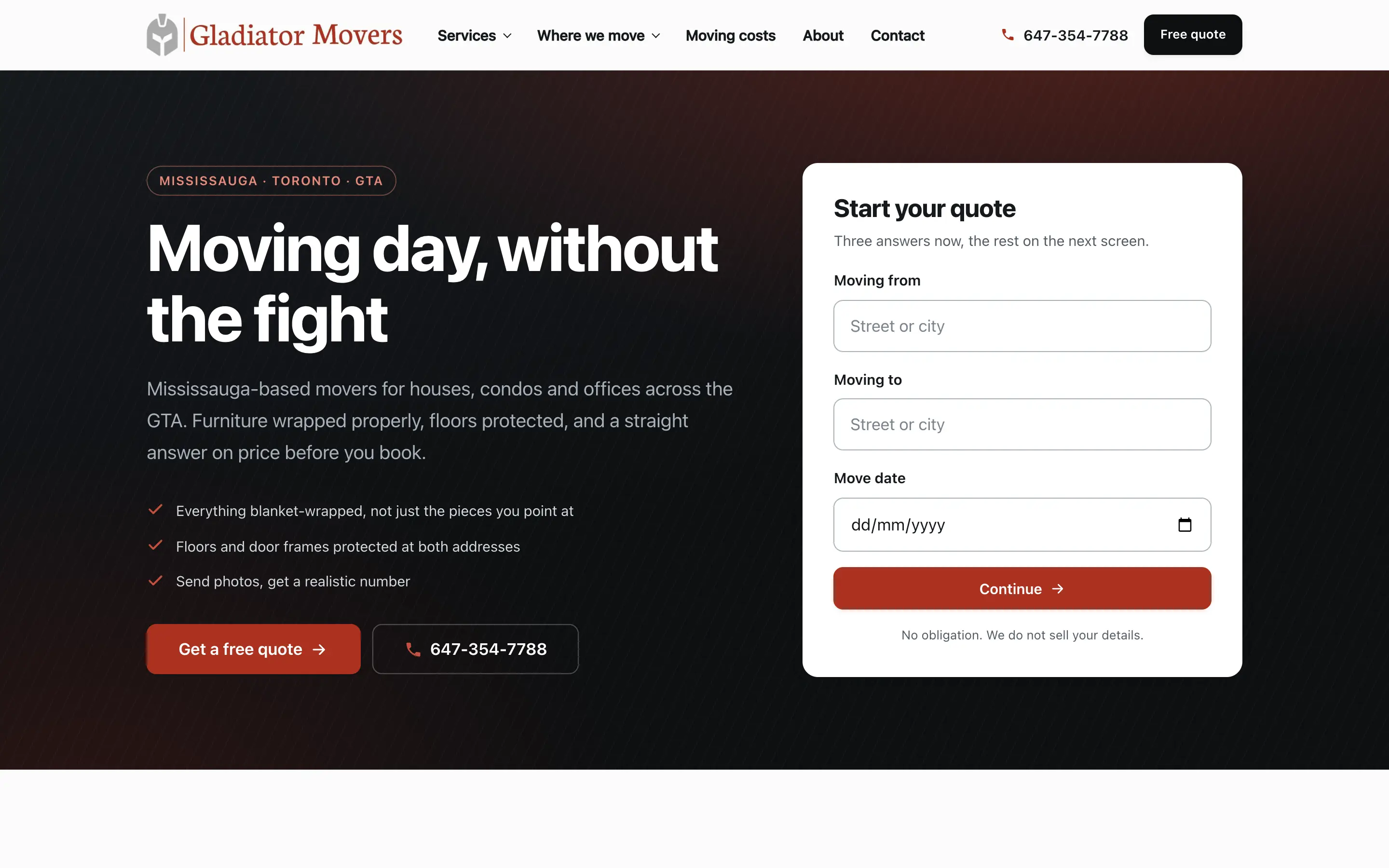
A moving company site where the quote starts in the hero, service pages exist for every job type, and the whole thing is built around one action: get a real number.
Toronto & the GTA
Buyers now ask an assistant before they ask a search engine, and a business that is not named in that answer never learns it was considered. InceptiCode makes Toronto business sites retrievable, quotable and identifiable — then measures whether it worked.
Foundations included in every build · ongoing work scoped per business
or call +1 647 691 5063
Answer-engine runs recorded over time · crawler access verified from logs · nothing promised that cannot be measured
Real projects
Service pages, service-area pages and structured data, built for businesses whose customers search by trade and by neighbourhood. Every one is live.
A moving company site where the quote starts in the hero, service pages exist for every job type, and the whole thing is built around one action: get a real number.
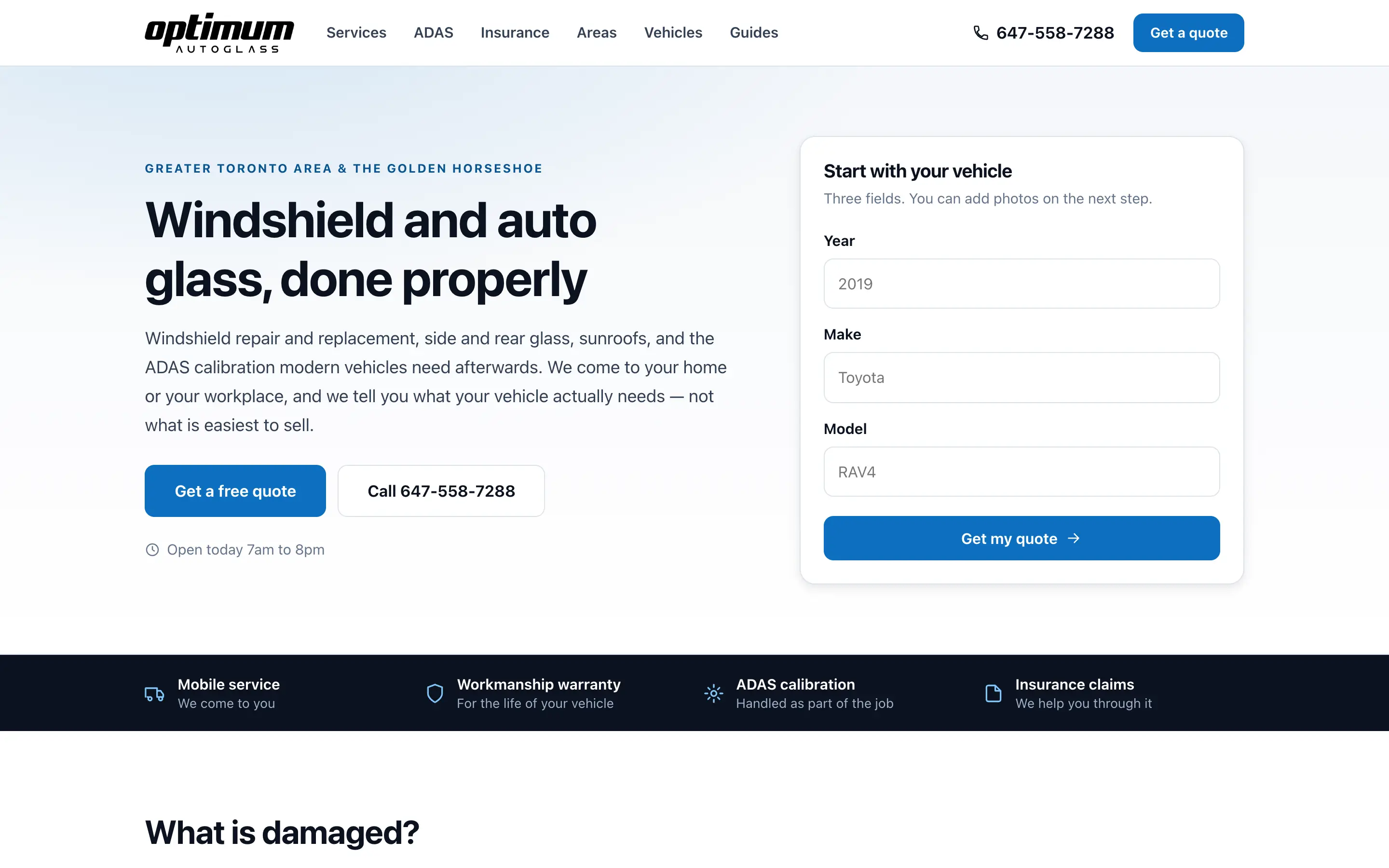
An auto glass site that asks for the vehicle first, explains ADAS and insurance plainly, and has a landing page for every service, area and vehicle people search.
A high-end renovation site where the process, the permits and the FAQ do the selling — because that is what a homeowner spending six figures actually needs to see.
Visit live site — BuildNova Construction (opens in a new tab)
Pricing
Technical foundations are included in every build and business websites start at C$2,490. Ongoing search and answer-engine work is scoped to the business rather than sold as a package, because the right amount for a single-location trades company and for a multi-service firm are not the same number.
Most requested
A professional site for an established business that needs to win more work.
From C$2,490
Most projects: C$2,490–C$4,990
Shopify or WooCommerce, set up to actually sell — not just to look finished.
From C$3,990
Most projects: C$5,900–C$8,900+
What's included
No part of this is sold with a ranking guarantee. Search results are not for sale, ranking factors are not published in full, and generative engines return different answers to the same question on different runs. What can be promised is that the site becomes eligible, measurable and quotable — and that you will be shown the measurements either way.
How it works
No discovery invoices, no scope creep, no surprise change orders halfway through.
A short call or a form. What you do, who buys from you, what you want the website to bring in. No technical questions.
InceptiCode comes back with a page-by-page plan and a fixed price. You approve it before anything is designed or built.
The key pages are designed properly, with your content in them rather than a wireframe. Two rounds of revisions are built into the price.
The approved design gets built — responsive, fast, with forms and tracking wired up as part of the work.
A staging link goes to you, and you go through it properly. Content, links, forms, phone numbers. Anything wrong gets fixed before launch.
InceptiCode handles DNS, hosting and the cutover, submits the sitemap to Google, and confirms tracking is recording. Then we stay reachable.
Why InceptiCode
A set of real buying questions is put to the assistants on a schedule, and two things are recorded per run: whether the business was named, and whether it was cited with a link. That history is what makes a trend visible. Almost everyone selling this category reports on rankings and hopes nobody asks about the rest.
GPTBot, OAI-SearchBot, ClaudeBot and PerplexityBot are separate user agents from Googlebot, and a security plugin with a blanket bot rule removes a site from their answers entirely. Server and CDN logs settle the question in an hour. Being blocked by accident is common and invisible from the outside.
A retriever cuts a page into chunks of roughly 130 to 170 words around a heading, and whatever sits under it has to make sense alone. A section that opens "It handles Canadian tax by province" is unusable once extracted; naming the subject in the sentence is what makes a passage attributable.
Structured data works when every page agrees about what the organisation is, using stable identifiers rather than each page declaring an unconnected node. That consistency, matched across the website, the Google Business Profile and any directory listing, is what lets a model be confident enough to name you.
Titles, meta descriptions, canonicals, structured data, heading structure, a sitemap submitted to Search Console and fast loading are part of every InceptiCode build at no extra cost. That is what makes a site eligible. Campaign work is separate, and InceptiCode will tell you when Google Ads would serve you better than waiting six months for organic results.
Google Search does not use llms.txt for ranking or AI Overviews, most published files are never fetched, and no measured citation effect exists. This site publishes one anyway because it is cheap and correct. Anybody selling it as a growth lever is selling a file rather than a result.
FAQ
Classic SEO is about being retrievable and rankable in a list of links. Answer-engine work is about being quotable — whether an assistant like ChatGPT, Perplexity, Copilot or Google AI Mode can lift a correct, self-contained sentence out of your page and attribute it to you. The technical foundations overlap heavily, but the writing does not: a passage that reads well in context can be useless once it is separated from the page around it.
No, and nobody can. Search results are not sold, ranking factors are not published in full, and generative engines return different answers to the same question on different runs. What InceptiCode can do is make a site technically eligible, structurally clear, factually quotable and measurable — then report what actually happened. Any agency offering a guaranteed position is either misunderstanding the product or misrepresenting it.
Yes. Titles, meta descriptions, canonical URLs, structured data, heading structure, a sitemap submitted to Google Search Console, fast loading and a sensible page hierarchy are part of every build at no extra cost. That is what makes a site eligible to rank. Ongoing campaign work — content production, local citations, digital PR — is separate, and we will tell you honestly when a business would get more from Google Ads than from waiting six months for organic results.
Very little, and it should be sold that way. Google Search does not use llms.txt for ranking or AI Overviews, most files are never fetched, and no measured citation effect exists. Anthropic recommends it and some retrieval workflows respect it, so this site publishes one because it is cheap and correct — not because it ranks. Anyone selling llms.txt as an AI-search growth lever is selling a file, not a result.
By measuring the two things separately. Search Console reports impressions, clicks and positions for classic search. For answer engines, InceptiCode runs a set of real buying questions against them on a schedule and records whether the business is named and whether it is cited, so the trend is visible over time rather than inferred from a single lucky screenshot.
Every site we build includes the technical foundations: page titles, meta descriptions, canonical URLs, structured data, a sitemap submitted to Google Search Console, fast loading, and a sensible page structure. That is what makes a site eligible to rank. Ongoing SEO — content, links, local listings — is separate work, and we will tell you honestly whether you need it or whether InceptiCode should point you at Google Ads instead.
Our business websites start at C$2,490, and most business projects land between C$2,490–C$4,990. Online stores start at C$3,990, with larger stores typically C$5,900–C$8,900+. What moves a project up the range is page count, custom functionality, integrations, whether we write the content, and multilingual requirements. You get a fixed price in writing before any work starts.
Yes, and it is a large part of what we do. The important part of a redesign is not the look — it is keeping the search rankings and traffic you already have. We map your existing URLs, set up proper 301 redirects, keep the pages that are earning visits, and improve the structure around them.
If your business is not in the answer, send us the question you asked and the address of your site. We will tell you which of the three steps you are failing — retrieval, extraction or attribution.
Call us and you get a person, not a queue. We normally reply within one business day.