Gladiator Movers
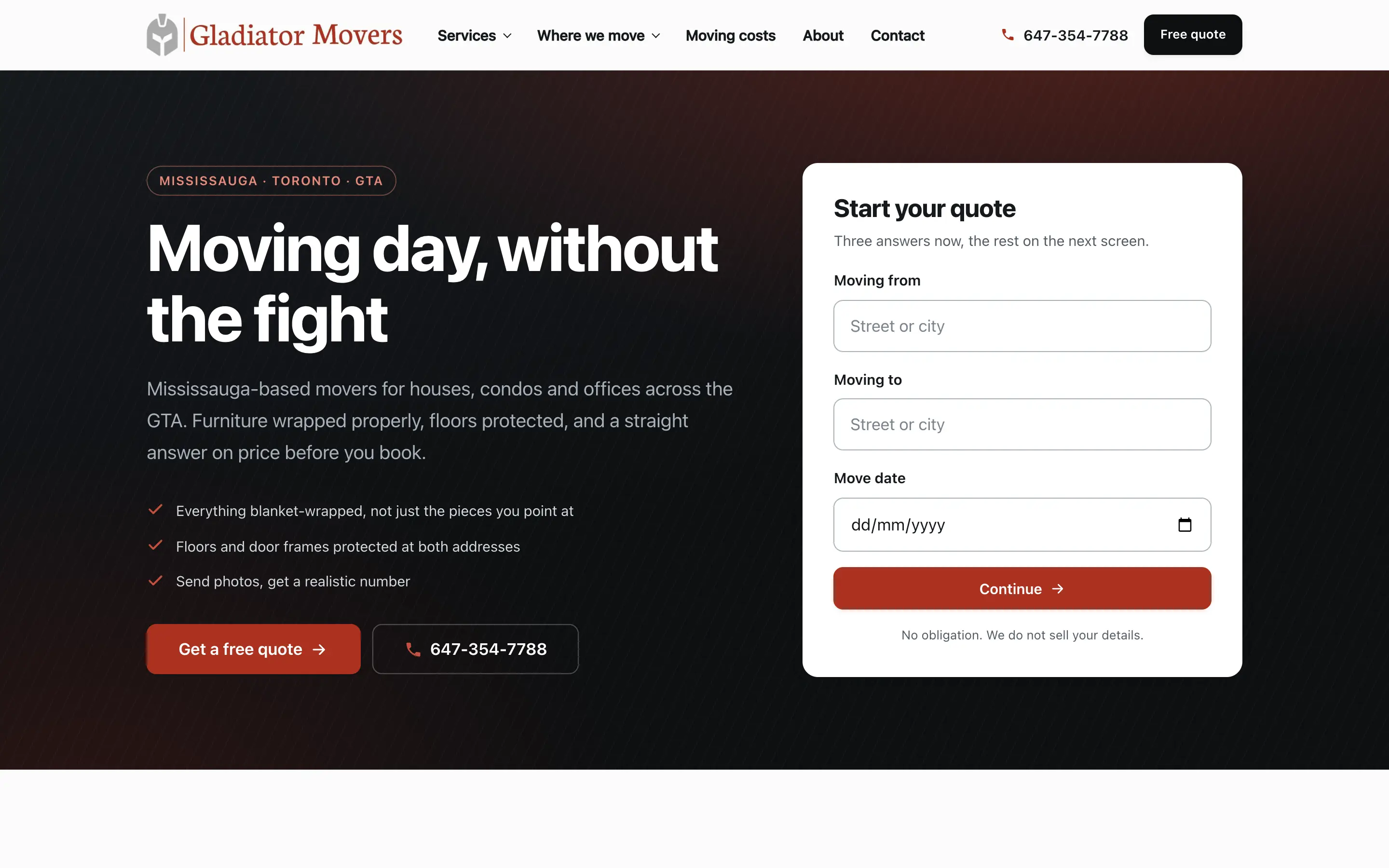
A moving company site where the quote starts in the hero, service pages exist for every job type, and the whole thing is built around one action: get a real number.
Toronto & the GTA
InceptiCode builds booking systems, quote calculators, customer portals and connections to the software Toronto businesses already run on — built around how your business actually works.
Scoped and fixed-priced before development starts
or call +1 647 691 5063
Discovery first · Written scope · Fixed price before we build · You own the code
Real projects
Multi-step quote flows with photo upload, service-area logic, and forms that reach the business reliably. All live, all usable right now.
A moving company site where the quote starts in the hero, service pages exist for every job type, and the whole thing is built around one action: get a real number.
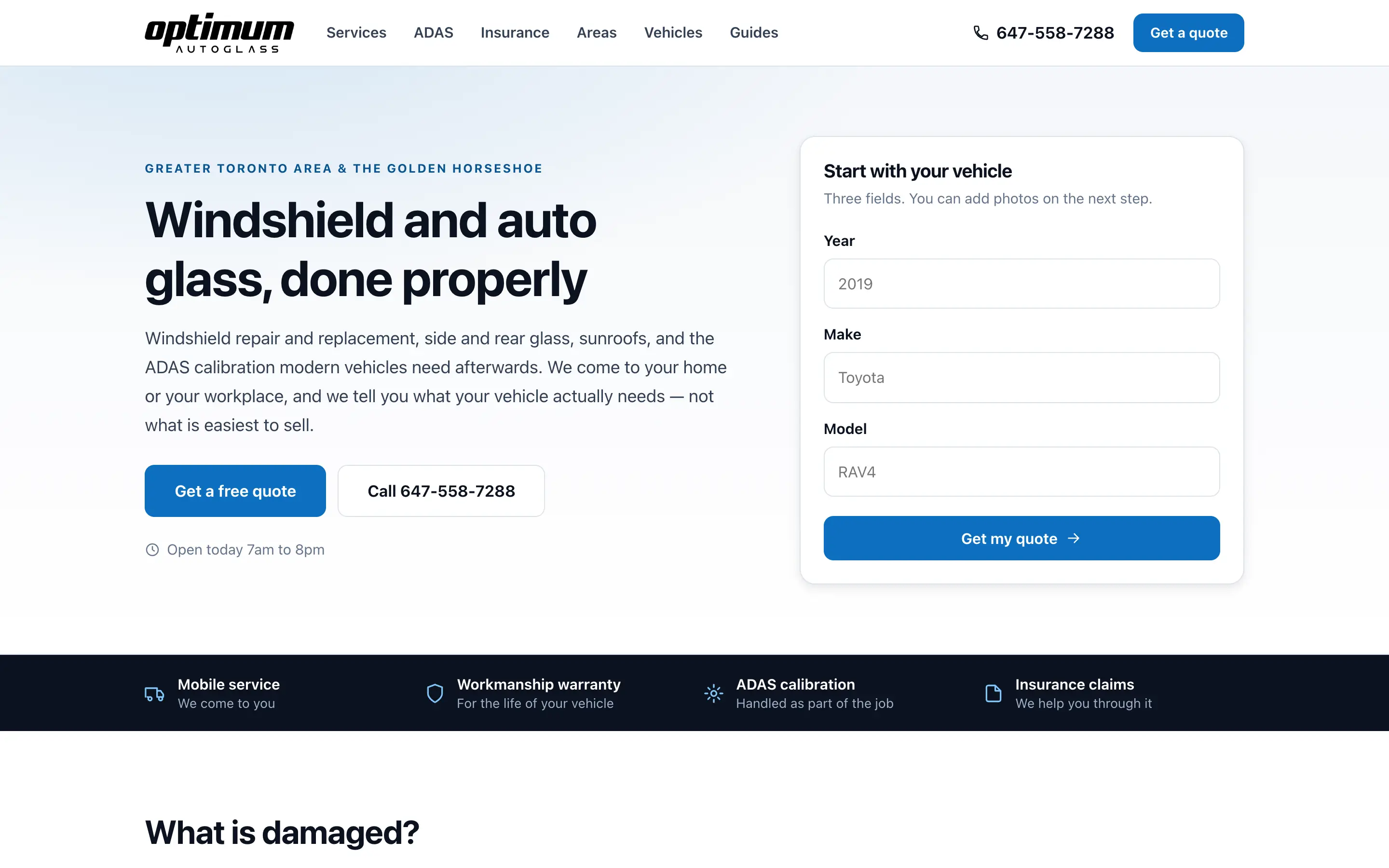
An auto glass site that asks for the vehicle first, explains ADAS and insurance plainly, and has a landing page for every service, area and vehicle people search.
A full online store with cart and checkout, built Arabic-first with a proper right-to-left layout and an English switch — not a translated afterthought.
Pricing
There is no honest starting price for open-ended functional work, so we do not invent one. We scope it, then fix the price. If it sits on top of a normal business website, the website part uses the published pricing below.
Most requested
A professional site for an established business that needs to win more work.
From C$2,490
Most projects: C$2,490–C$4,990
Internal tools, portals and systems built around how your business runs.
Scoped per project
What's included
Ongoing hosting, third-party service subscriptions and any API costs are paid by you, directly, in your name. We will tell you what they are before you commit, not after.
How it works
No discovery invoices, no scope creep, no surprise change orders halfway through.
A short call or a form. What you do, who buys from you, what you want the website to bring in. No technical questions.
InceptiCode comes back with a page-by-page plan and a fixed price. You approve it before anything is designed or built.
The key pages are designed properly, with your content in them rather than a wireframe. Two rounds of revisions are built into the price.
The approved design gets built — responsive, fast, with forms and tracking wired up as part of the work.
A staging link goes to you, and you go through it properly. Content, links, forms, phone numbers. Anything wrong gets fixed before launch.
InceptiCode handles DNS, hosting and the cutover, submits the sitemap to Google, and confirms tracking is recording. Then we stay reachable.
Why InceptiCode
Functional work goes wrong when nobody establishes what it has to do before someone starts building. We do that first, in writing, and you approve it.
The person entering ten jobs a day is the real user, not the customer who visits once. If the internal side is painful the system gets abandoned regardless of how good it looks.
A lot of what businesses ask us to build already exists as a plugin, an app or an off-the-shelf tool for a fraction of the cost. We will point you at it. We would rather do the piece you actually need custom.
Conventional stack, readable code, documentation, and a handover. If another developer picks it up in two years, they should be able to work with it.
Not against a documentation example. If it talks to your CRM, we test it against your CRM before it goes live.
Once the scope is settled the price is settled. Changes are priced and approved separately, before they are built.
FAQ
Design is how the site looks and how the pages are organised. Development is what the site does — a booking system, a quote calculator, a customer login area, a job-request workflow, a connection to the software you already run on. Most business websites need a little of it; some need a lot.
Because there is no honest starting number for open-ended functional work — a booking form and a dispatch portal are not the same project. What we do instead is scope it properly first: we work out what the system has to do and who uses it, then give you a fixed price before development begins. If the functionality sits on top of a normal business website, the website part is priced from C$2,490 as usual and the custom work is quoted separately on top.
Usually yes, and often that is the cheaper answer. We will look at what your site is built on and tell you whether the functionality can be added cleanly or whether the existing build will fight it. If it will fight it, we will say so rather than charging you to find out slowly.
That is a large part of this work — CRMs, email platforms, accounting, dispatch and scheduling software, inventory systems, payment providers. What matters is whether the system has an API and what it exposes. Tell us what you run and we will check before quoting.
You do. The code, the hosting and the accounts are yours, and we will hand over the repository and the documentation at the end. We do not build things that only we can maintain.
A straightforward business website is usually three to five weeks from approved scope to launch. Larger sites and online stores typically run six to ten weeks. The single biggest factor is how quickly content and feedback come back from your side — we will tell you the honest timeline for your project before you commit, not an optimistic one.
Launch is not the last conversation. We stay available for the settling-in period, confirm your analytics and Search Console are reporting correctly, and fix anything that turns out to be wrong with the build. Ongoing maintenance and support are available separately if you want them — they are not compulsory.
Tell us what is slow, manual or falling through the cracks. Working out what should be built is the part we are good at — and often the answer is smaller than you expect.
Call us and you get a person, not a queue. We normally reply within one business day.