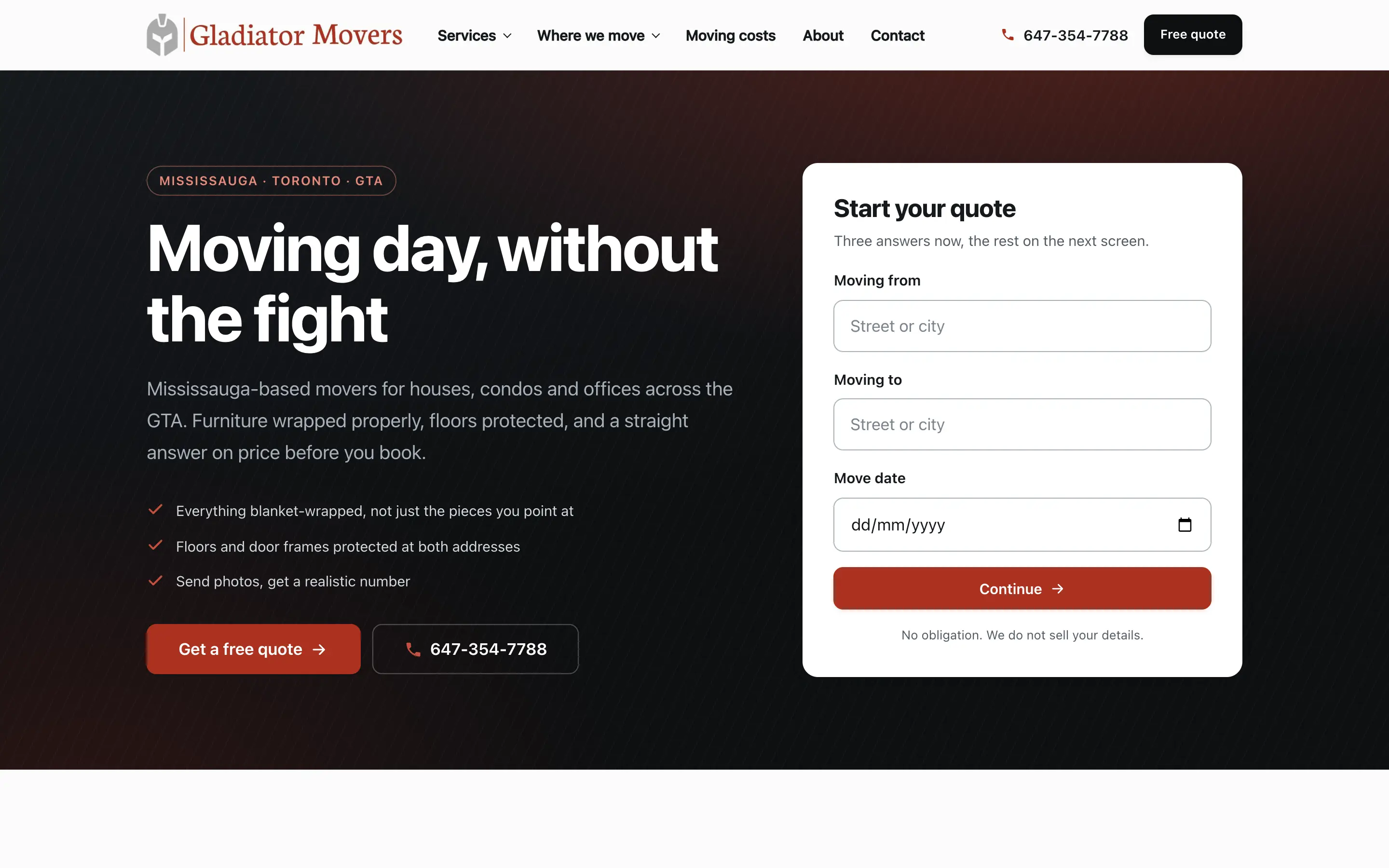
Gladiator Movers
A moving company site where the quote starts in the hero, service pages exist for every job type, and the whole thing is built around one action: get a real number.
Healthcare & Clinics
A clinic website is judged in the ninety seconds between a patient deciding they need care and choosing who to book with, and most of that decision is made on details a clinic considers administrative: whether you are accepting new patients, whether you take their insurance, and how soon they can be seen. InceptiCode builds dental, medical and allied-health sites in Toronto and the GTA around those three answers, under the privacy rules that apply the moment a website collects anything about a patient.
Business websites from C$2,490, fixed in writing before design starts.
The buying decision
Nobody chooses a clinic the way they choose a contractor. There is no comparison spreadsheet and no quote — there is a symptom, an insurance card, and a short list of practices within a reasonable distance. The patient is looking for four things and will leave within seconds if the site hides any of them: are you accepting new patients, do you direct-bill my plan, what is the soonest appointment, and where exactly do I park. Credentials matter, but they qualify you rather than win you the booking; the practice that wins is the one that removes the phone call.
What that changes
Six decisions that follow directly from how this purchase gets made, rather than from what looks good in a portfolio.
Either a real online booking integration against the system the clinic already runs — Jane, Dentrix, Cliniko, Acuity — or a request form that states plainly how quickly it is answered. What does not work is a phone number alone: a large share of patients researching in the evening will simply book with whoever accepts a booking at the moment they decide.
Root canals, Invisalign, emergency dentistry, sports physiotherapy, orthotics, massage therapy — each is a separate search by a patient with a specific problem, and each carries a different anxiety. A combined "Our Services" list competes for none of them and reassures nobody.
Which plans you direct-bill, whether you accept assignment, and what a patient pays out of pocket. Clinics treat this as reception's job and it is quietly the most-read paragraph on a clinic website — a patient who cannot find it phones a competitor rather than phoning you to ask.
A clinic is almost always a health information custodian under Ontario's PHIPA, and a booking form collects personal health information the moment it asks what brings someone in. PHIPA requires reasonable safeguards, written terms with whoever handles that information on your behalf, and a retention and disposal schedule you can actually produce. What it does not do is require the data to be stored in Canada — that is the most common thing clinics are told about it, and it is not in the Act. Canadian hosting is a sensible default, not a legal minimum. The build is the same either way: encryption in transit, no patient detail in analytics or ad pixels, retention that is enforced, and a consent notice that says what happens to the message. A booking form that emails symptom descriptions in plain text through a third-party service is the failure worth avoiding. Where your own obligations sit — including whether federal PIPEDA reaches any part of what you do — is a question for a lawyer rather than for a web agency.
Patients choose a practitioner, not a clinic. Each provider needs a real page: registration number and college, languages spoken, what they treat most, and a photograph taken this decade. Languages in particular convert in the GTA in a way that surprises clinics who have never stated them.
Ontario's accessibility regulation sets the website conformance requirement at WCAG 2.0 Level AA for public sector organisations and for private and non-profit organisations with 50 or more employees, so whether it binds your practice depends on headcount — many clinics sit under that line. The reason to build to it anyway is the audience, which skews toward patients with low vision, motor difficulty and screen readers. Booking flows are the part that breaks — date pickers and multi-step forms are the two most commonly inaccessible components on the web. This is built to WCAG 2.2 AA and tested with a keyboard, not asserted in a footer link.
Common mistakes
Every one of these is something we have found on a live site in this industry, and every one costs enquiries that were already earned.
Evidence
InceptiCode has not yet published a healthcare case study, and this page says so rather than implying one. What transfers is specific: Optimum Auto Glass is a booking-led service business where the site's job is to convert an urgent, unplanned need into a scheduled appointment, which is structurally the same problem as a clinic's; and the accessibility and privacy work described above is the same work this site itself is built to — WCAG 2.2 AA, tested with a keyboard, and a lead pipeline that stores no more than it needs. We would rather state that than show a stethoscope photograph and imply clinical experience we have not earned.
A moving company site where the quote starts in the hero, service pages exist for every job type, and the whole thing is built around one action: get a real number.
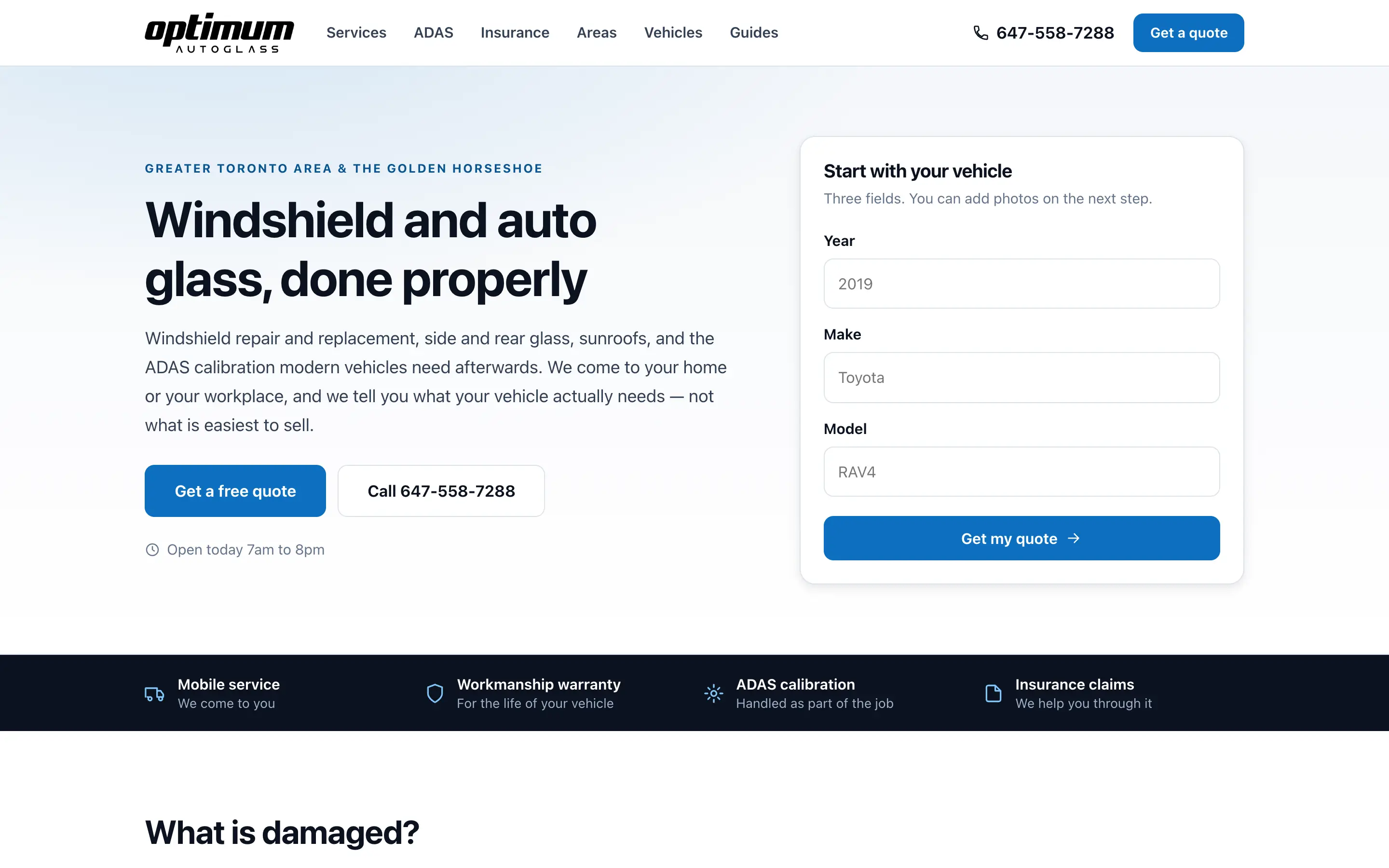
An auto glass site that asks for the vehicle first, explains ADAS and insurance plainly, and has a landing page for every service, area and vehicle people search.
A full online store with cart and checkout, built Arabic-first with a proper right-to-left layout and an English switch — not a translated afterthought.
How it works
The same process whatever the sector — because the thing that changes by industry is what gets built, not how the project runs.
A short call or a form. What you do, who buys from you, what you want the website to bring in. No technical questions.
InceptiCode comes back with a page-by-page plan and a fixed price. You approve it before anything is designed or built.
The key pages are designed properly, with your content in them rather than a wireframe. Two rounds of revisions are built into the price.
The approved design gets built — responsive, fast, with forms and tracking wired up as part of the work.
A staging link goes to you, and you go through it properly. Content, links, forms, phone numbers. Anything wrong gets fixed before launch.
InceptiCode handles DNS, hosting and the cutover, submits the sitemap to Google, and confirms tracking is recording. Then we stay reachable.
FAQ
Usually yes. Jane, Cliniko, Acuity, Dentrix Ascend and most modern practice-management systems expose either an embeddable booking widget or a documented API, and either can be built into the site so a patient books without leaving it. Where a system offers neither — some older dental software does not — the honest answer is a request form that sets a clear response expectation, and we will tell you which case you are in before quoting rather than after.
Yes. In Ontario the law that attaches is PHIPA, and it attaches from the moment the information is collected — a contact form asking "what brings you in?" collects it whether or not a record is ever kept. PHIPA has been declared substantially similar to Part 1 of the federal PIPEDA, so a custodian collecting within the province is generally not regulated twice over; PIPEDA still reaches commercial activity outside the custodian role and information that crosses a provincial or national border. The practical consequences are concrete: submissions should travel encrypted, be stored somewhere you can name, be deleted on a schedule, and never be copied into analytics or advertising tools. Most clinic sites fail the last one without knowing it, because a page URL naming a condition is itself health information once it is attached to a visitor. What PHIPA does not do is require the data to stay in Canada — worth knowing, because it is frequently sold that way. This describes how we build; your own obligations are a question for a lawyer.
If patients choose their practitioner — physiotherapy, dentistry, psychotherapy, chiropractic — then yes, and those pages usually outperform the home page for new-patient enquiries. If the practice is genuinely interchangeable, such as a walk-in clinic, a single team page is enough. The test is whether a patient would ever search a practitioner's name, because if they would, that search should land somewhere you control.
Carefully, and the constraint is professional rather than technical. Ontario's regulatory colleges restrict testimonials for several regulated health professions outright, and where they are permitted the patient's written consent is required. The safer and usually more effective route is linking to your public Google reviews, which patients trust more than a quote on your own site anyway. We will build whichever the college rules allow, but we will not write them.
Typically ten to sixteen: home, about, one page per significant service, a page per practitioner, insurance and fees, new-patient information, contact and booking. The count is far less important than the split — one combined services page is the single most common reason a clinic with good care gets found by nobody searching for the specific thing it treats.
More answers on the FAQ page and the pricing page.
What you do, who buys from you, and what the site has to bring in. Business websites from C$2,490. We normally reply within one business day.