Gladiator Movers
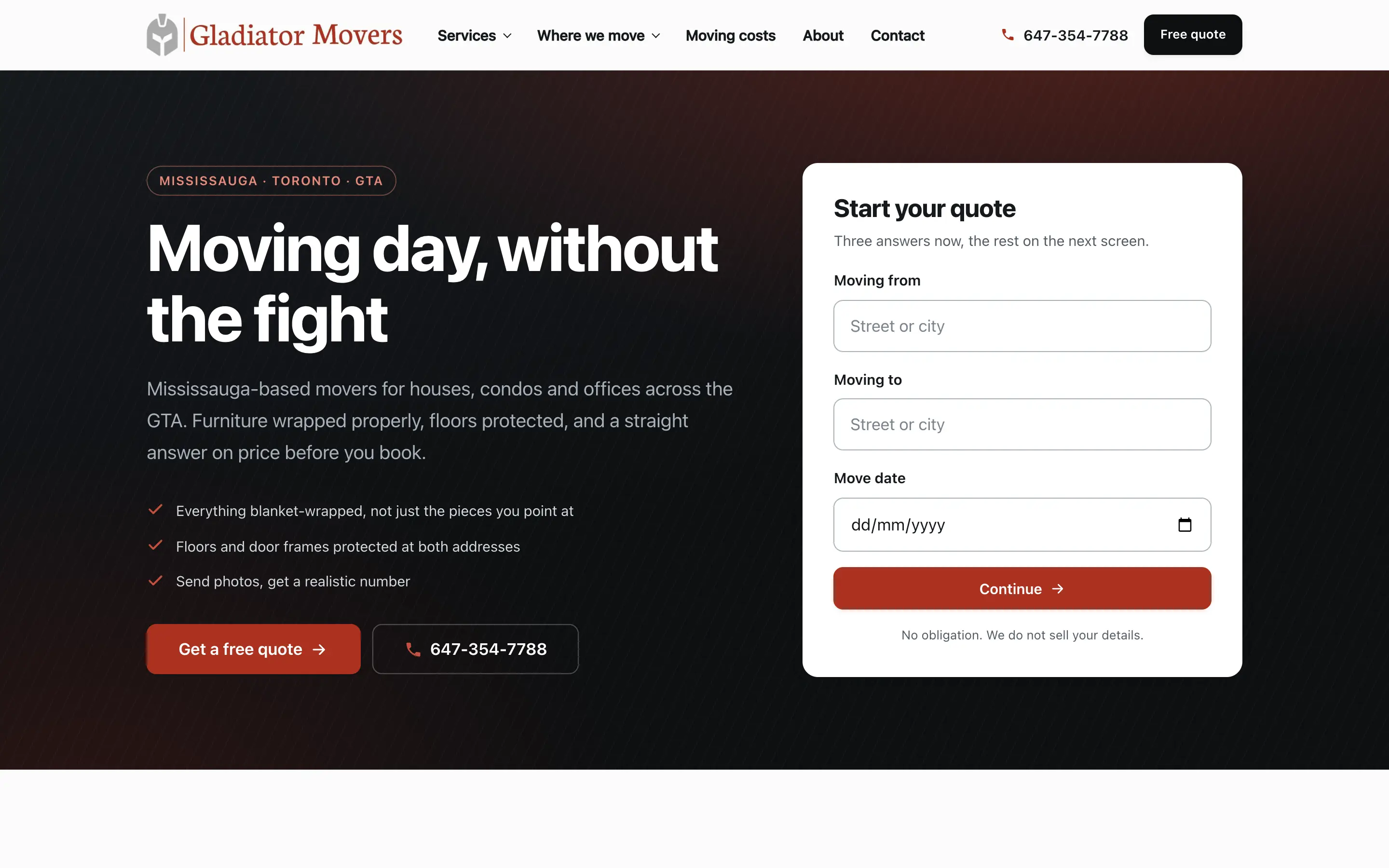
A moving company site where the quote starts in the hero, service pages exist for every job type, and the whole thing is built around one action: get a real number.
Home Services & Trades
Home services is the most competitive local search category in the GTA, and it splits cleanly in two: emergencies, where the fastest answer wins, and planned work, where the most credible answer wins. InceptiCode builds trades websites in Toronto and the GTA that are explicit about which of the two the business is selling.
Business websites from C$2,490, fixed in writing before design starts.
The buying decision
An emergency customer with a flooded basement or no heat in February is not reading an about page. They want a number they can tap, a statement that someone is available now, and an area list that includes them. A planned-work customer replacing a roof or a furnace behaves completely differently — they gather quotes over a fortnight, compare warranties and financing, and read reviews carefully. Most trades sites are built for one of these customers and quietly lose the other.
What that changes
Six decisions that follow directly from how this purchase gets made, rather than from what looks good in a portfolio.
One path for "I need someone today", another for "I am getting three quotes this month". Mixing them produces a page that serves neither well.
The emergency customer converts on the phone, not on a form. The number should be tappable, visible without scrolling, and repeated as the page continues.
Furnace repair, furnace replacement, air conditioning, water heaters, drain clearing, panel upgrades — each is its own search with its own urgency and its own price band.
Trades lose more time to out-of-area enquiries than to a shortage of them. Naming the municipalities and the neighbourhoods covered pre-qualifies every call.
Licence numbers, insurance status and the warranty on parts and labour. In a category with a trust problem, the businesses that publish these details separate themselves from the ones that do not.
If jobs are scheduled through field-service software, the website should feed it rather than creating a second inbox nobody checks on a Saturday.
Common mistakes
Every one of these is something we have found on a live site in this industry, and every one costs enquiries that were already earned.
Evidence
InceptiCode has not yet built for a plumbing, electrical or HVAC company specifically. The closest live work is BuildNova Construction, a renovation business selling on documented process and permits, and Optimum Auto Glass, an urgent-service business with thirteen service-area pages and a mobile dispatch model — which between them cover both halves of how a trades site has to behave. We would rather say that plainly than show you a sector logo we have not earned.
A moving company site where the quote starts in the hero, service pages exist for every job type, and the whole thing is built around one action: get a real number.
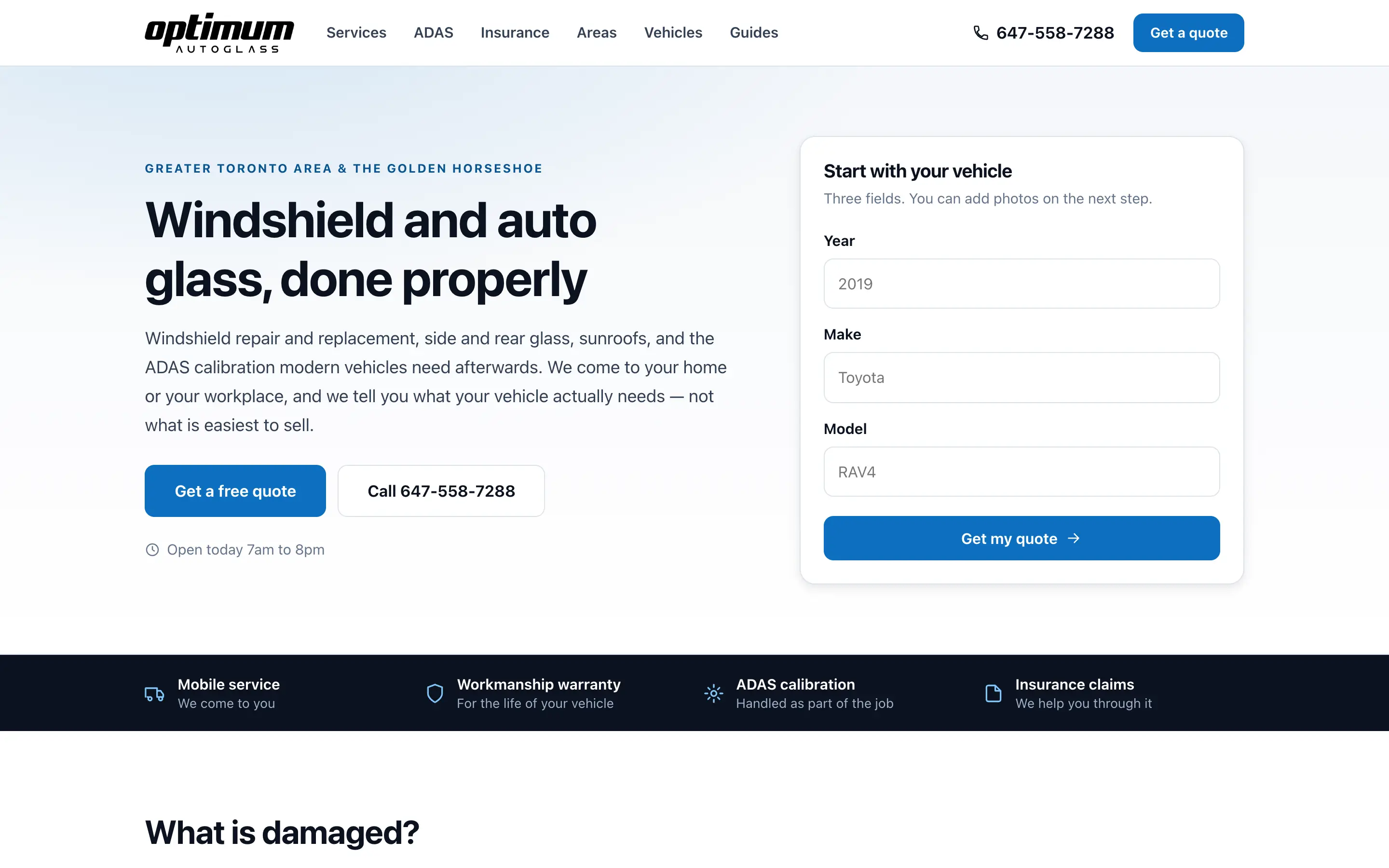
An auto glass site that asks for the vehicle first, explains ADAS and insurance plainly, and has a landing page for every service, area and vehicle people search.
A full online store with cart and checkout, built Arabic-first with a proper right-to-left layout and an English switch — not a translated afterthought.
How it works
The same process whatever the sector — because the thing that changes by industry is what gets built, not how the project runs.
A short call or a form. What you do, who buys from you, what you want the website to bring in. No technical questions.
InceptiCode comes back with a page-by-page plan and a fixed price. You approve it before anything is designed or built.
The key pages are designed properly, with your content in them rather than a wireframe. Two rounds of revisions are built into the price.
The approved design gets built — responsive, fast, with forms and tracking wired up as part of the work.
A staging link goes to you, and you go through it properly. Content, links, forms, phone numbers. Anything wrong gets fixed before launch.
InceptiCode handles DNS, hosting and the cutover, submits the sitemap to Google, and confirms tracking is recording. Then we stay reachable.
FAQ
Enough to cover the radius you would genuinely drive to, and no more. For most GTA trades that means six to twelve municipalities plus the neighbourhoods within the ones you work in most. Every additional page for an area you would decline is a page that generates calls you have to turn down, and turning down calls costs more hours than the page ever earns.
Yes, because both of those channels send people to check you. A HomeStars profile or a Google Business Profile generates the click; the website is where the customer decides whether to call, and it is the only one of the three you own outright. It is also where licence numbers, warranty terms and service areas can be stated in full, none of which a directory listing gives you room for.
More answers on the FAQ page and the pricing page.
What you do, who buys from you, and what the site has to bring in. Business websites from C$2,490. We normally reply within one business day.