Gladiator Movers
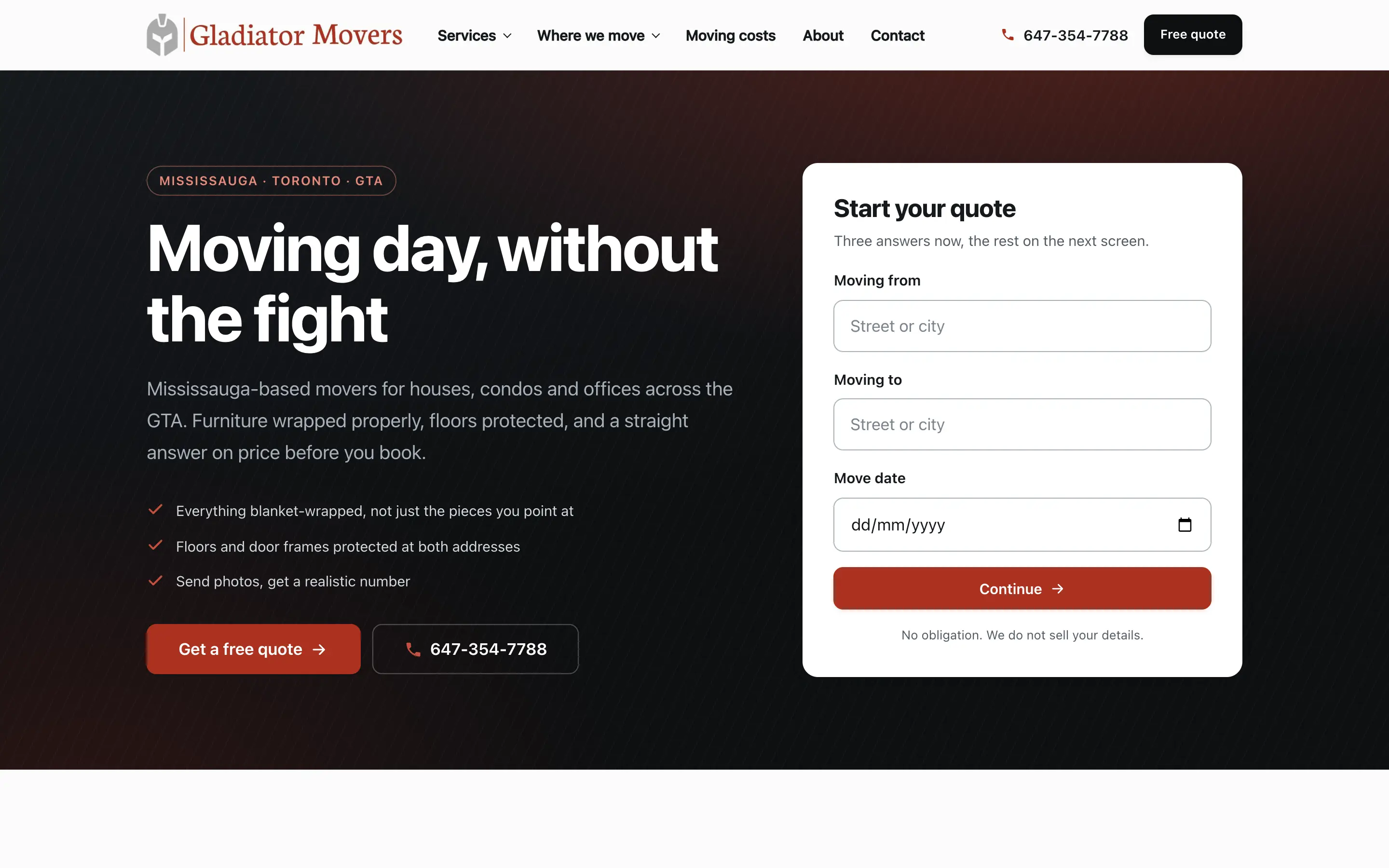
A moving company site where the quote starts in the hero, service pages exist for every job type, and the whole thing is built around one action: get a real number.
Real Estate & Property
Real estate is the one sector where the website cannot win on inventory: by the time a buyer reaches an agent's site, they have already seen every listing on the portals. InceptiCode builds agent, brokerage and property-management sites in the GTA around what the portals cannot carry — the specific neighbourhoods you actually know, the process you actually run, and the evidence that you have done this before in this price band.
Business websites from C$2,490, fixed in writing before design starts.
The buying decision
A seller choosing a listing agent is making one of the largest financial decisions of their life, on a commission they know is negotiable, and they are choosing between three agents who all claim to be local experts. What decides it is evidence and specificity: what you sold, where, how recently, at what relationship to asking, and what you will actually do — staging, photography, pre-list preparation, marketing spend, communication cadence. A buyer, meanwhile, wants search that works and a reason to register that is worth an email address. Property management is a third buyer again, an owner evaluating an operator on fees, vacancy handling and how fast a maintenance call gets answered. All three are unmoved by a hero photograph of a skyline.
What that changes
Six decisions that follow directly from how this purchase gets made, rather than from what looks good in a portfolio.
Not a boundary description and a stock photo. What the housing stock actually is, what a detached versus a townhouse trades in, which streets carry a premium and why, the schools people actually move for, transit, and what is under construction. This is the highest-return content in the sector and the most commonly templated, which is why the templated ones rank for nothing.
Recent sales with the neighbourhood, the property type, the price band and a short line on what the situation was. Board rules govern how sold data may be displayed and those rules are followed, but "sold in Leaside, March, over asking" with a photograph beats "Top 1% Producer" by a wide margin, because one is checkable and the other is a badge every competitor also has.
Listing search on your own site means a data feed under a board agreement, real ongoing cost, and display rules that must be respected. It is worth it for a team generating registrations at volume, and it is dead weight for a solo agent whose leads come from referral and reputation. We will tell you which you are before it is quoted, because retrofitting a feed is expensive and removing one is embarrassing.
The lead magnets in this sector are notorious: an "instant valuation" that produces a number nobody stands behind, and a forced registration wall after three listing views. Both generate volume and burn goodwill. A valuation request answered by a person within a day converts worse on paper and vastly better into signed listings.
A meaningful share of traffic is someone standing outside a property, on cellular data, tapping. That governs image weight, map behaviour and how quickly a call or text reaches you. A site that takes six seconds on LTE has already lost that person to the portal app they came from.
RECO and board rules govern how a registrant advertises: brokerage name and the correct registration terms displayed properly, no misleading claims, no unauthorised use of board data or the trademarked terms. This is a discipline applied to the templates, not a disclaimer added at the end.
Common mistakes
Every one of these is something we have found on a live site in this industry, and every one costs enquiries that were already earned.
Evidence
InceptiCode has not yet published a real estate case study and will not claim one. What transfers is the part of this sector that is structural rather than industry-specific: the neighbourhood and service-area architecture described above is precisely the eleven-area structure built for Gladiator Movers, and the credibility-and-process problem — a high-value purchase decided on documented process and verifiable evidence rather than on price — is the BuildNova Construction build almost exactly. The parts we would be learning are the board data rules and RECO advertising requirements, and we would rather say so now than discover them mid-project.
A moving company site where the quote starts in the hero, service pages exist for every job type, and the whole thing is built around one action: get a real number.
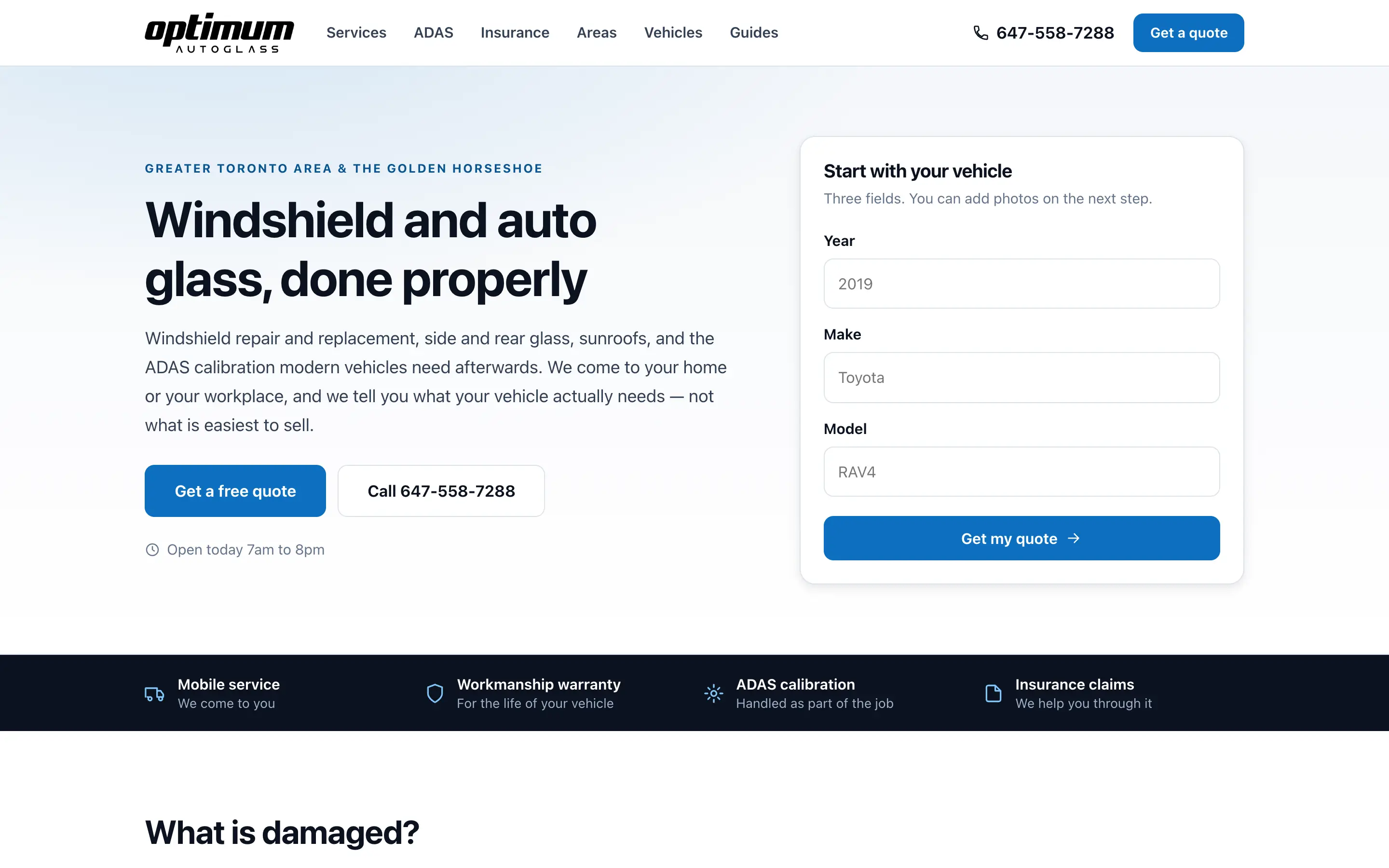
An auto glass site that asks for the vehicle first, explains ADAS and insurance plainly, and has a landing page for every service, area and vehicle people search.
A full online store with cart and checkout, built Arabic-first with a proper right-to-left layout and an English switch — not a translated afterthought.
How it works
The same process whatever the sector — because the thing that changes by industry is what gets built, not how the project runs.
A short call or a form. What you do, who buys from you, what you want the website to bring in. No technical questions.
InceptiCode comes back with a page-by-page plan and a fixed price. You approve it before anything is designed or built.
The key pages are designed properly, with your content in them rather than a wireframe. Two rounds of revisions are built into the price.
The approved design gets built — responsive, fast, with forms and tracking wired up as part of the work.
A staging link goes to you, and you go through it properly. Content, links, forms, phone numbers. Anything wrong gets fixed before launch.
InceptiCode handles DNS, hosting and the cutover, submits the sitemap to Google, and confirms tracking is recording. Then we stay reachable.
FAQ
Less often than the industry assumes. IDX means an ongoing data-feed cost, a board agreement and display rules to respect, and it earns that back only when the site generates registrations at real volume — a team with an advertising budget, typically. For most individual agents the leads come from referral, reputation and neighbourhood search, and the money is far better spent on genuinely good neighbourhood pages and sold evidence. We will give you a straight recommendation before quoting, including when the answer costs us the larger build.
Specificity. Sellers are choosing between agents who all say the same things, so what moves them is evidence they can check and a process they can picture: what you sold nearby and when, what you do before the listing goes live, who pays for staging and photography, how the offer night is handled, and how often they will hear from you. A page that answers those in plain language outperforms every award badge on the site, because the badges are on the competitors' sites too.
Only if you are prepared to stand behind the number, and most are not. An automated estimate from public data is wrong often enough in a market like the GTA that the first thing you do on the appointment is explain why your own website was misleading. A "request a valuation" form answered personally within a business day produces fewer leads and considerably more listings, which is the metric that matters.
Yes, within the board rules that govern how sold data is displayed and attributed, which we follow rather than work around. In practice this is one of the highest-value sections on an agent site: recent, local, specific and checkable, which is the exact combination a seller is looking for and the exact combination a producer badge is not.
More answers on the FAQ page and the pricing page.
What you do, who buys from you, and what the site has to bring in. Business websites from C$2,490. We normally reply within one business day.