Gladiator Movers
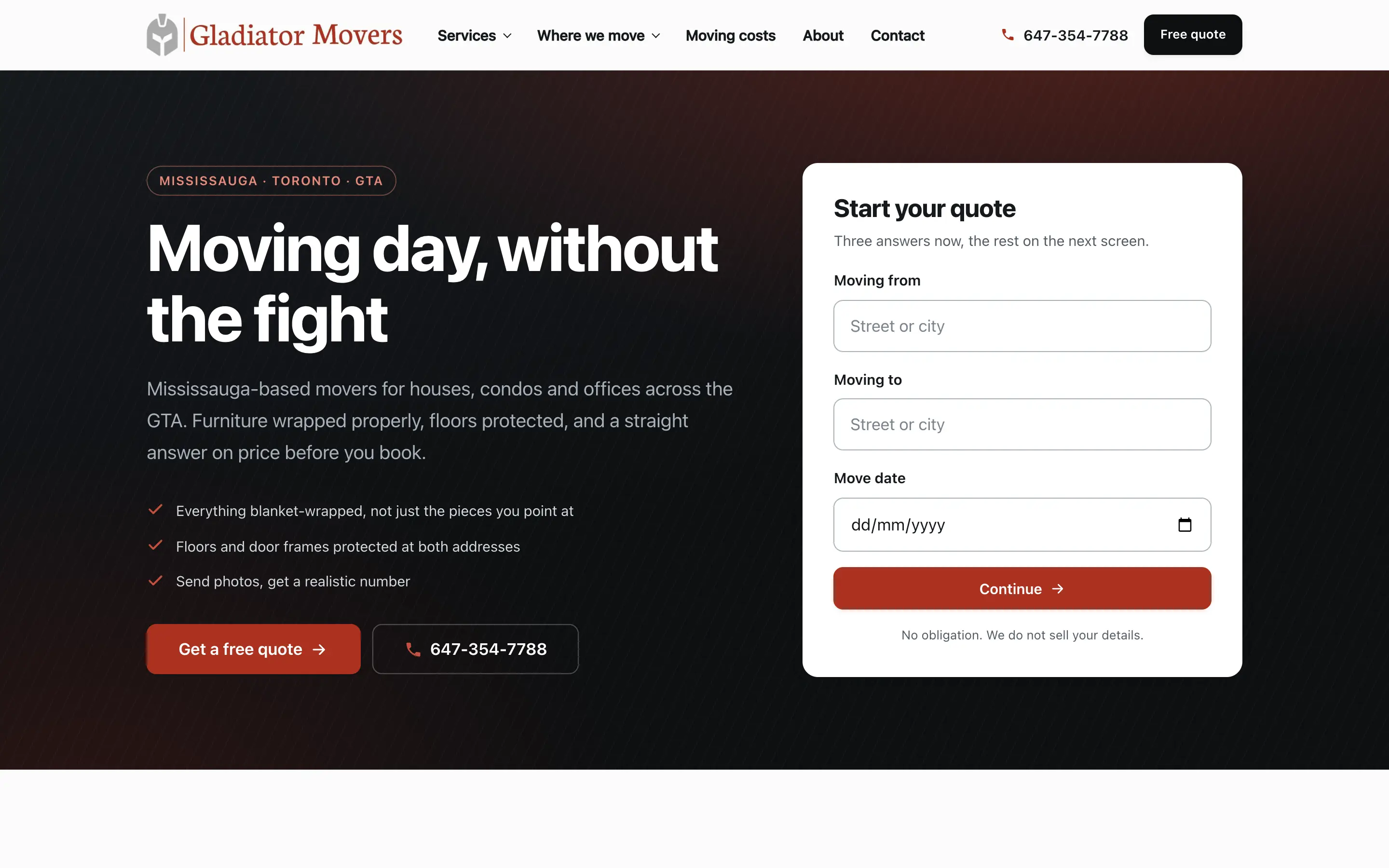
A moving company site where the quote starts in the hero, service pages exist for every job type, and the whole thing is built around one action: get a real number.
Toronto & the GTA
Website speed gets blamed on hosting, and on most business sites the real causes are images that were never resized and a stack of third-party scripts nobody has audited. InceptiCode measures a site on a throttled mobile profile and returns the fixes in the order they pay.
Audits scoped per site · performance work included in every build
or call +1 647 691 5063
Measured under 4× CPU throttling on Slow 4G · prioritised fix list · re-tested after the work
Real projects
Every project below is live. Load one on mobile data and watch how quickly the first screen settles — that is the measurement that actually decides whether somebody stays.
A moving company site where the quote starts in the hero, service pages exist for every job type, and the whole thing is built around one action: get a real number.
An auto glass site that asks for the vehicle first, explains ADAS and insurance plainly, and has a landing page for every service, area and vehicle people search.
A full online store with cart and checkout, built Arabic-first with a proper right-to-left layout and an English switch — not a translated afterthought.
Pricing
Performance work is part of every InceptiCode build rather than an upsell, and business websites start at C$2,490. Optimising a site somebody else built is scoped after the audit, because the honest price depends on whether the platform is the problem.
Most requested
A professional site for an established business that needs to win more work.
From C$2,490
Most projects: C$2,490–C$4,990
Shopify or WooCommerce, set up to actually sell — not just to look finished.
From C$3,990
Most projects: C$5,900–C$8,900+
What's included
If the audit concludes that the platform itself is the limit, we will say so and tell you what a rebuild would cost instead of selling a tuning retainer that fights the same battle every month. That answer is common on sites built with heavy page builders and it is not a criticism of the site — it is arithmetic.
How it works
No discovery invoices, no scope creep, no surprise change orders halfway through.
A short call or a form. What you do, who buys from you, what you want the website to bring in. No technical questions.
InceptiCode comes back with a page-by-page plan and a fixed price. You approve it before anything is designed or built.
The key pages are designed properly, with your content in them rather than a wireframe. Two rounds of revisions are built into the price.
The approved design gets built — responsive, fast, with forms and tracking wired up as part of the work.
A staging link goes to you, and you go through it properly. Content, links, forms, phone numbers. Anything wrong gets fixed before launch.
InceptiCode handles DNS, hosting and the cutover, submits the sitemap to Google, and confirms tracking is recording. Then we stay reachable.
Why InceptiCode
This site measures Largest Contentful Paint at around one second under 4× CPU throttling on a Slow 4G profile, with Cumulative Layout Shift at zero and under 10 kB of first-party JavaScript. Every page is measured against the budget rather than one flattering page being quoted, by a script kept in the repository that runs before deploys — which is the only reason a figure like that can be published at all.
The first deliverable is a list of what is actually costing you time, in order, with the saving next to each item. On most business sites images and third-party scripts account for the majority of it, and both are cheap to fix — we would rather tell you that than sell a rebuild.
A performance score from an unthrottled desktop browser on a fast connection describes nobody. Testing runs on a throttled mobile profile because that is what the customer standing in a parking lot is actually using.
A page that moves while it loads makes people tap the wrong thing and leave. Reserving space for images, embeds and late-loading elements is unglamorous work that removes an entire category of abandonment.
When the page builder itself is the bottleneck, each round of tuning buys less than the last and the next content update undoes part of it. At that point a rebuild is cheaper over any horizon longer than a year, and saying so costs us an engagement we would rather not sell.
A speed engagement that ends with a fast site and no guardrails regresses within months. Image handling, script policy and a weight budget are set up so the next person to add a page does not undo the work by accident.
FAQ
Images that were never resized, third-party scripts, and page builders that ship large amounts of unused CSS and JavaScript. On most business sites the single biggest cost is images, and the second is the accumulated tags — chat widgets, analytics, pixels, review embeds — each added by someone who assumed it was free. Hosting is far less often the cause than it gets blamed for.
Core Web Vitals are three measurements Google publishes: Largest Contentful Paint, how long the main content takes to appear; Interaction to Next Paint, how quickly the page responds when tapped; and Cumulative Layout Shift, how much the page moves while loading. They are a genuine, though modest, ranking input. Their real value is as a proxy for whether the site feels broken on a mid-range phone, which is what actually costs enquiries.
A useful target is main content appearing within 2.5 seconds on a mid-range phone over a throttled mobile connection, with no visible layout shift. For reference, incepticode.com measures Largest Contentful Paint at around one second under 4× CPU throttling and a Slow 4G profile — inside Google's 2.5-second threshold by a wide margin — with Cumulative Layout Shift at zero. Those figures come from a test script kept in the repository and run before deploys, and every page is checked against the budget rather than one flattering page being quoted.
Often yes, and it is worth trying first. Image compression and correct sizing, removing tags nobody uses, deferring what does not block rendering, and fixing layout shift will get most business sites into a respectable range. The point where a rebuild becomes the cheaper answer is when the theme or page builder itself is the bottleneck — at which stage optimisation work is being spent propping up something that will keep regressing.
Our business websites start at C$2,490, and most business projects land between C$2,490–C$4,990. Online stores start at C$3,990, with larger stores typically C$5,900–C$8,900+. What moves a project up the range is page count, custom functionality, integrations, whether we write the content, and multilingual requirements. You get a fixed price in writing before any work starts.
A straightforward business website is usually three to five weeks from approved scope to launch. Larger sites and online stores typically run six to ten weeks. The single biggest factor is how quickly content and feedback come back from your side — we will tell you the honest timeline for your project before you commit, not an optimistic one.
Hosting is not included in the build price, and we deliberately keep it in your name rather than reselling it to you. We will recommend a suitable host for your site, set it up, and hand you the account. Typical hosting for a business site runs a few hundred dollars a year, paid directly to the host.
A first measurement takes minutes and tells you whether this is an afternoon of image work or something structural. You get the answer either way.
Call us and you get a person, not a queue. We normally reply within one business day.