Gladiator Movers
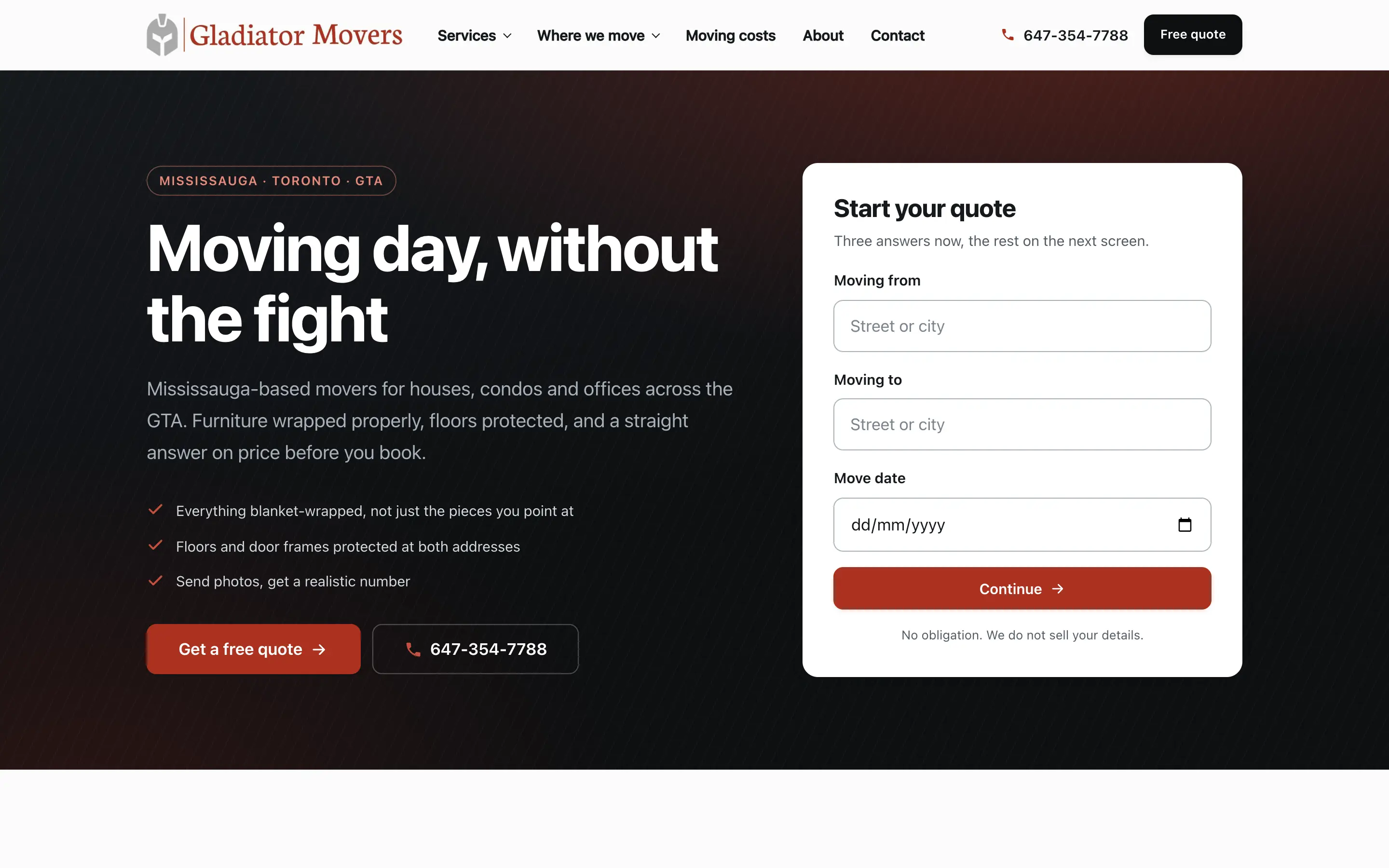
A moving company site where the quote starts in the hero, service pages exist for every job type, and the whole thing is built around one action: get a real number.
Logistics & Freight Forwarding
Freight forwarding is bought by a procurement process, not by an impulse, and a freight forwarder’s website is read by someone who is comparing four suppliers on the same afternoon. InceptiCode builds logistics and supply-chain sites in Toronto and the GTA around that reading: what you move, on which lanes, under which customs authority, and who to call about it.
Business websites from C$2,490, fixed in writing before design starts.
The buying decision
The buyer is a shipper, an importer or a manufacturer’s logistics coordinator, and they are not price-shopping a single container — they are deciding whether this supplier is a credible counterparty for a relationship measured in years. What they are looking for is specific and unglamorous: the modes you actually operate, the lanes and ports you actually cover, whether you hold a customs brokerage licence or partner for it, whether you carry the bonded and insurance status the cargo requires, and whether someone answers within the business day. A site that leads with a stock photograph of a container ship and the phrase "global solutions" answers none of it, which is why so many freight sites are indistinguishable from each other.
What that changes
Six decisions that follow directly from how this purchase gets made, rather than from what looks good in a portfolio.
Ocean freight, air freight, rail, LTL and FTL trucking, warehousing and distribution, and customs clearance are six different searches run by six different people with different cargo. A combined services page competes for none of them and answers none of them properly. This is the single largest structural difference between a freight site that gets found and one that does not.
A shipper can tell you origin, destination, mode, incoterm, commodity, weight and volume, and whether it is hazardous — and wants to give you all of it in one pass so the reply is a real number rather than a request for more information. That is a structured form with conditional fields, not a message box. It also has to keep working when someone pastes a spreadsheet of forty line items into it.
Named origin and destination regions, the ports and terminals you actually work through, and the border crossings you clear. A shipper moving from Ningbo to Toronto is looking for those words, and a page that says "worldwide coverage" gives them nothing to match against.
CBSA business number, customs brokerage licence or the broker you partner with, bonded warehouse status, cargo insurance, CIFFA or similar membership, and liability terms. In this sector these are not trust badges — they are the qualifying criteria a procurement checklist is literally ticking off, and burying them on an About page costs the enquiry.
A large share of GTA freight and import business is conducted in Simplified Chinese, and a Quebec-facing lane needs French. That means separate URLs per language, hreflang, localised metadata and a form that accepts and correctly stores non-Latin text — decided at build time. Retrofitting a second language onto a site that assumed one is close to a rebuild, which is why it belongs in the first scope rather than the second phase.
If you already run a TMS or WMS that exposes an API, a tracking lookup or a customer portal on the site is an integration against it. If you do not, the honest answer is a clean handoff to the carrier’s own tracking rather than a shipment database the website has no business owning. InceptiCode builds the integration where a documented API exists; where one does not, we will say so before the quote rather than after it.
Commercial invoices, packing lists, bills of lading and customs paperwork move alongside the freight. Where a site handles them at all, uploads must be size-limited, type-restricted, stored outside the web root and reachable only through an authenticated view — not emailed as attachments and not sitting on a public URL that anyone who guesses the filename can read.
Common mistakes
Every one of these is something we have found on a live site in this industry, and every one costs enquiries that were already earned.
Evidence
InceptiCode has not yet published a freight forwarding case study, and this page will say so until one exists. What transfers directly is structural rather than cosmetic: Gladiator Movers is a multi-service, multi-area transport business whose site is built around getting a real number to a comparison-shopping buyer quickly, and BuildNova Construction is a high-consideration B2B build where documented process and credentials carry the decision. A freight forwarder’s site is those two problems at once, in two languages. We would rather set that out plainly than show a container photograph and imply sector experience we have not earned.
A moving company site where the quote starts in the hero, service pages exist for every job type, and the whole thing is built around one action: get a real number.
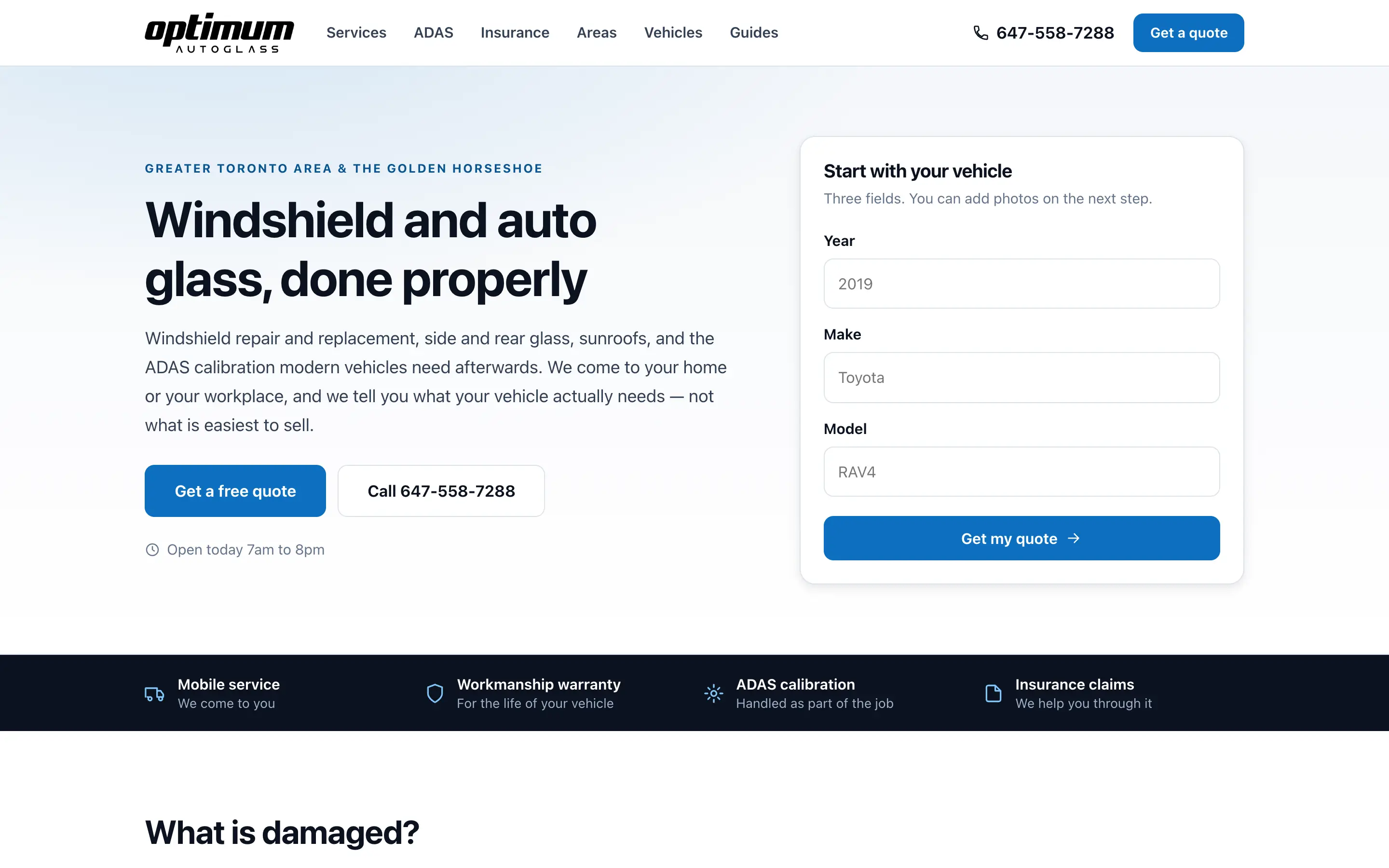
An auto glass site that asks for the vehicle first, explains ADAS and insurance plainly, and has a landing page for every service, area and vehicle people search.
A full online store with cart and checkout, built Arabic-first with a proper right-to-left layout and an English switch — not a translated afterthought.
How it works
The same process whatever the sector — because the thing that changes by industry is what gets built, not how the project runs.
A short call or a form. What you do, who buys from you, what you want the website to bring in. No technical questions.
InceptiCode comes back with a page-by-page plan and a fixed price. You approve it before anything is designed or built.
The key pages are designed properly, with your content in them rather than a wireframe. Two rounds of revisions are built into the price.
The approved design gets built — responsive, fast, with forms and tracking wired up as part of the work.
A staging link goes to you, and you go through it properly. Content, links, forms, phone numbers. Anything wrong gets fixed before launch.
InceptiCode handles DNS, hosting and the cutover, submits the sitemap to Google, and confirms tracking is recording. Then we stay reachable.
FAQ
Yes, and it is better decided now than later. A real bilingual build means a separate URL per language, hreflang annotations so search engines serve the right one, translated titles, descriptions and structured data rather than translated body text alone, and a contact form that accepts and stores Chinese characters without mangling them. A translation widget does none of that: it produces one URL, so there is nothing for Google or Bing to index in Chinese, and no Chinese-language search can find you.
Typically eight to twelve in English before any second language: home, about, one page per mode you operate, warehousing, customs, and contact. The count matters far less than the split — six modes on one page is the mistake that costs the most search visibility in this sector, because each mode is a separate search by a separate buyer.
Where your TMS, WMS or carrier exposes a documented API, yes — that is a normal integration and it is quoted as one. Where no such API exists, we will tell you before the quote rather than after it, and the right answer is usually a clean handoff to the carrier’s own tracking. A tracking page backed by nothing is worse than no tracking page, because it invites a customer to test it.
Most of it. Importers, customs brokers, bonded warehouse operators and 3PLs share the same buyer behaviour: a procurement-led decision, credentials that qualify you before anyone calls, and a quote request that has to capture cargo detail in one pass. What changes is which pages carry the weight — a customs broker leads with clearance and compliance, a 3PL with facilities and fulfilment throughput.
Yes, all three, in your own accounts. This comes up in almost every logistics enquiry because it is a common failure mode with agency-hosted sites: the business discovers at renewal that the domain is registered to someone else. Registrar, DNS, hosting and the code are yours, and we will transfer them at any point without a discussion about it.
More answers on the FAQ page and the pricing page.
What you do, who buys from you, and what the site has to bring in. Business websites from C$2,490. We normally reply within one business day.