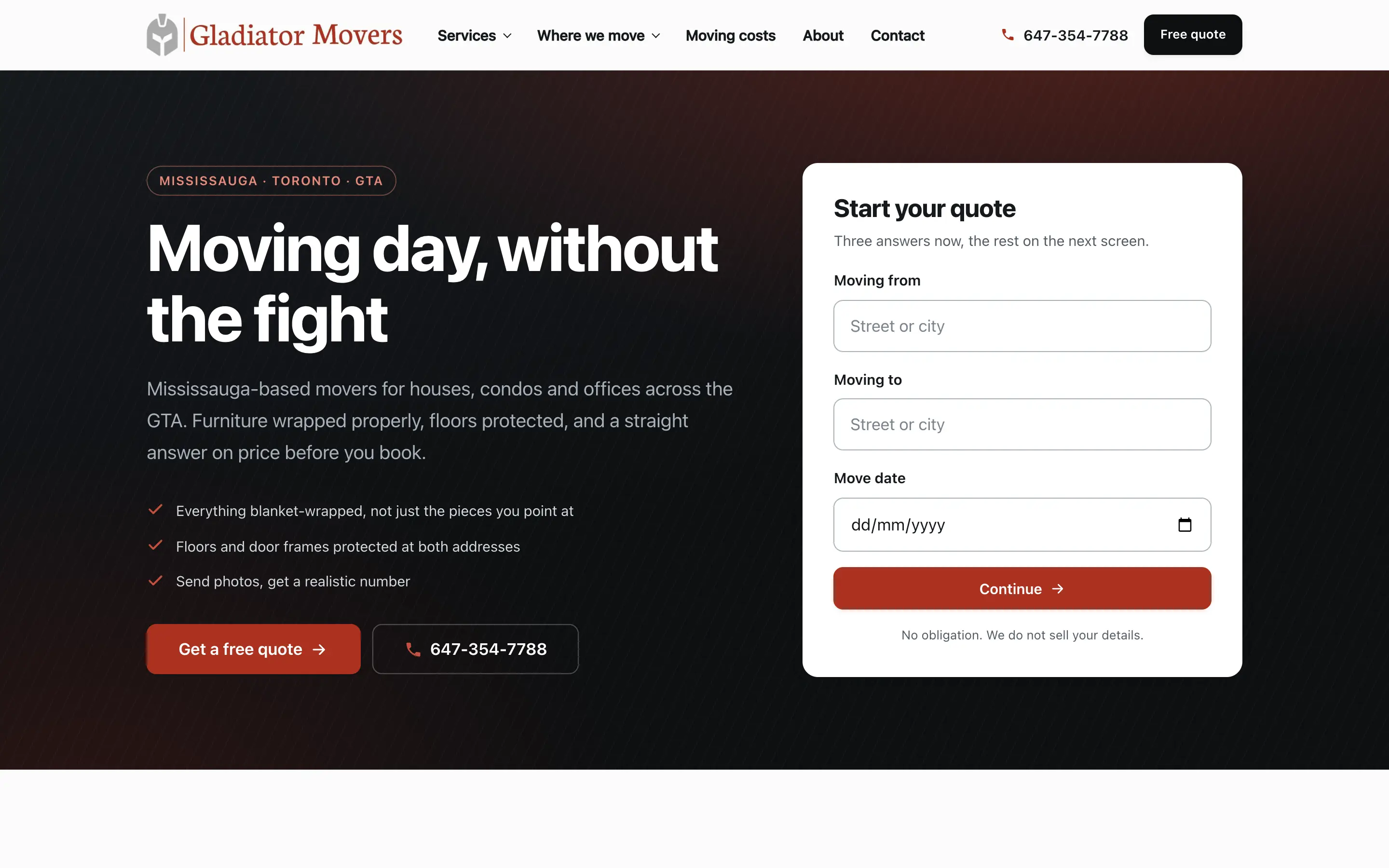
Gladiator Movers
A moving company site where the quote starts in the hero, service pages exist for every job type, and the whole thing is built around one action: get a real number.
Wholesale & Distribution
A wholesale website is not a shop. Its visitor is a purchaser doing a job: confirming a part number, checking whether something is in stock, and reordering what they bought last time — usually against an account with negotiated pricing that must not be visible to anyone else. InceptiCode builds distribution and wholesale sites in Toronto and the GTA around the catalogue and the account, in that order.
Business websites from C$2,490, fixed in writing before design starts.
The buying decision
The buyer is not persuaded, they are enabled or obstructed. They already know roughly what they want, they are working from a manufacturer part number, an old invoice or a spec sheet, and they are measuring you against the friction of phoning your counter. The decision is made twice: once when a new trade customer decides whether it is worth opening an account, on evidence of range, terms and whether you carry the brands they need; and then continuously, on whether reordering is faster here than by email. Consumer e-commerce instincts actively hurt in this category — a beautiful product page for a fitting nobody browses for is wasted, while a search that fails on a manufacturer part number loses the account.
What that changes
Six decisions that follow directly from how this purchase gets made, rather than from what looks good in a portfolio.
Manufacturer part numbers, your own SKUs, superseded numbers, OEM cross-references, and a description that does not match your catalogue’s wording. This is the single most important feature on a distribution site and the one most often left to a default keyword search that returns nothing for the most common query on the site.
The catalogue should be fully indexable — it is how a new trade customer finds you at all — while contract pricing sits behind a login and is specific to the account. The two requirements are not in conflict, but resolving them badly produces the common failure: an entire catalogue hidden behind a login, invisible to search, reachable only by customers who already know you exist.
A trade account application with business number, tax exemption status, references and terms is the real signup on a wholesale site, and it is usually a PDF to print. Made into a proper form that routes to credit for approval, it converts a materially higher share of the buyers who reached it.
Order history, saved lists, bulk entry by pasting a column of part numbers and quantities, and repeat-order in a couple of clicks. Most revenue on a distribution site is repeat, and the site earns its keep by being faster than emailing the rep — not by being prettier.
Live availability where the system can support it, a plain lead-time band where it cannot, and never a green "In stock" that the warehouse cannot back. A purchaser who is let down once on availability goes back to phoning, permanently, and the site loses the account it had already won.
Product data, pricing and stock belong in the system of record and should reach the site by import or integration. A catalogue maintained by hand in a CMS is accurate on the day it launches and wrong within a quarter, and the wrongness is invisible until a customer orders something that does not exist.
Common mistakes
Every one of these is something we have found on a live site in this industry, and every one costs enquiries that were already earned.
Evidence
InceptiCode has not published a wholesale case study, and the closest genuine work is stated rather than stretched. Opti4Club is a live e-commerce build — catalogue structure, product data and a checkout that had to be right about Canadian tax and shipping — which is the same data problem at a different scale, and the custom software work here is exactly the integration discipline a catalogue fed from an ERP needs. What we have not done is a live dealer portal with contract pricing, and we would rather say so before quoting than after.
A moving company site where the quote starts in the hero, service pages exist for every job type, and the whole thing is built around one action: get a real number.
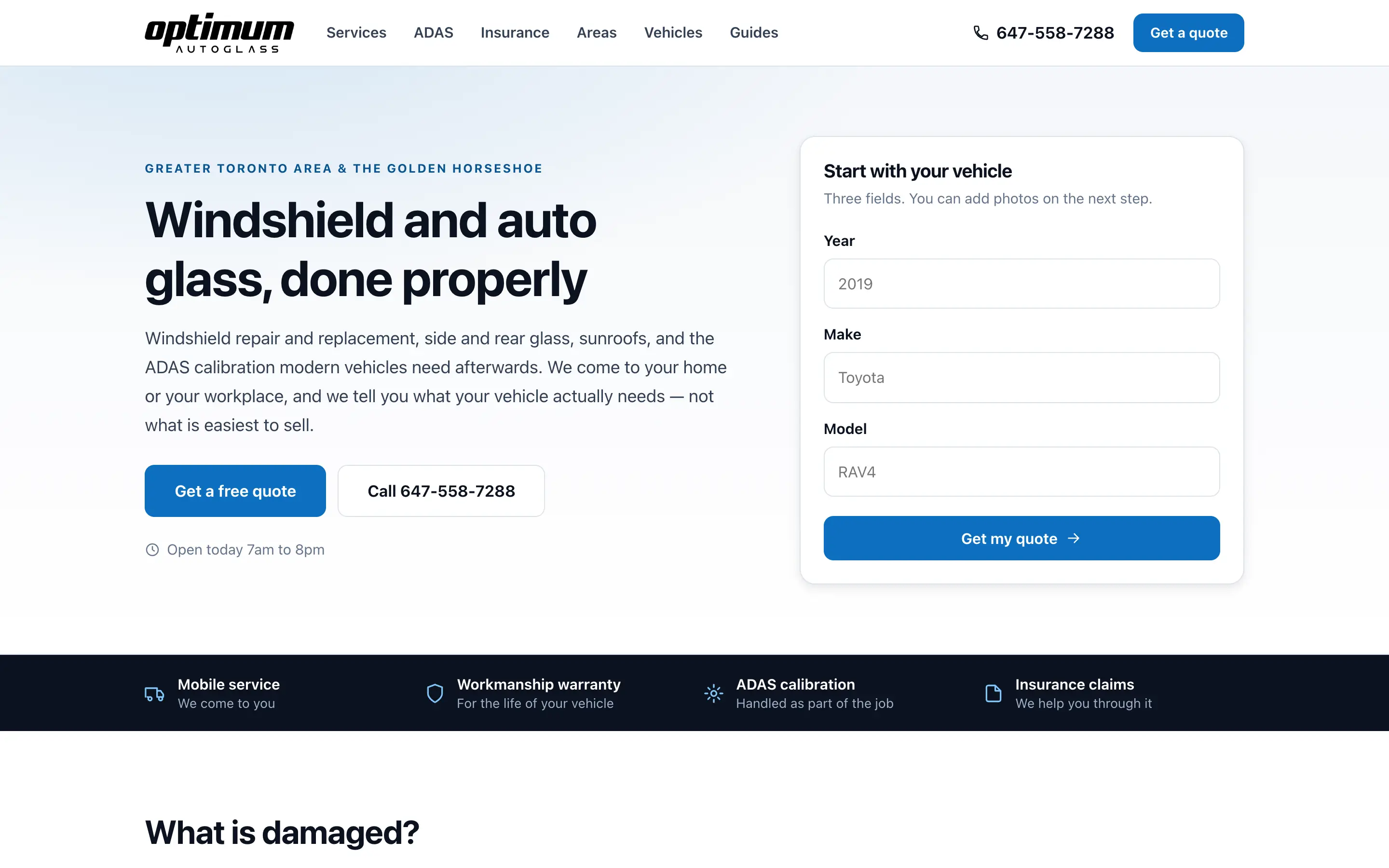
An auto glass site that asks for the vehicle first, explains ADAS and insurance plainly, and has a landing page for every service, area and vehicle people search.
A full online store with cart and checkout, built Arabic-first with a proper right-to-left layout and an English switch — not a translated afterthought.
How it works
The same process whatever the sector — because the thing that changes by industry is what gets built, not how the project runs.
A short call or a form. What you do, who buys from you, what you want the website to bring in. No technical questions.
InceptiCode comes back with a page-by-page plan and a fixed price. You approve it before anything is designed or built.
The key pages are designed properly, with your content in them rather than a wireframe. Two rounds of revisions are built into the price.
The approved design gets built — responsive, fast, with forms and tracking wired up as part of the work.
A staging link goes to you, and you go through it properly. Content, links, forms, phone numbers. Anything wrong gets fixed before launch.
InceptiCode handles DNS, hosting and the cutover, submits the sitemap to Google, and confirms tracking is recording. Then we stay reachable.
FAQ
The catalogue should be; the pricing usually should not. Almost every distributor needs the product pages indexable, because that is the only way a purchaser who does not yet know the business can find it — and hiding the catalogue behind a login is the most expensive mistake in this sector precisely because the cost is invisible. Contract pricing then sits behind the account login, per customer. A list price shown publicly with account pricing applied after login is a reasonable middle path where the trade will tolerate a published list.
It depends entirely on whether your customers would actually place orders themselves, and the honest answer for many distributors is that they would not at first. A catalogue with strong search, stock indication and a fast quote-request path captures most of the value and costs a fraction of a transactional build. Transactions are worth adding once you can see, in the request data, that customers are repeatedly ordering the same items — which is a measurement rather than a guess, and it is the sequence we would recommend.
Usually, and it is the difference between a catalogue that stays true and one that quietly stops being true. Most systems — whether that is a scheduled export, a database view or a documented API — can feed products, pricing and stock on a schedule the business chooses. Where an older system genuinely offers no route out, a periodic import is still far better than hand-maintenance. The part worth deciding early is which system is the source of truth for each field, because a catalogue with two sources of truth for price is a matter of time.
More answers on the FAQ page and the pricing page.
What you do, who buys from you, and what the site has to bring in. Business websites from C$2,490. We normally reply within one business day.