Gladiator Movers
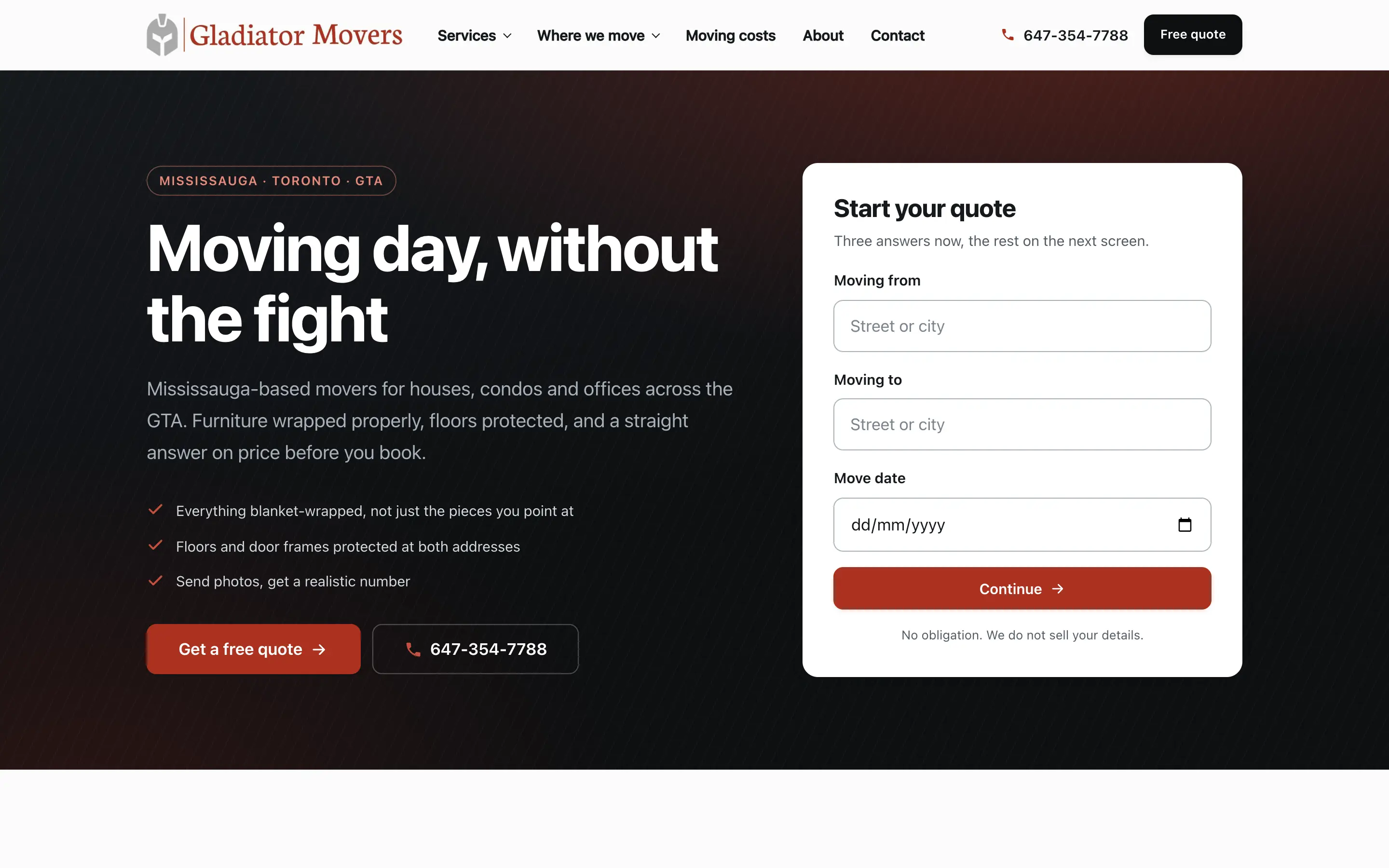
A moving company site where the quote starts in the hero, service pages exist for every job type, and the whole thing is built around one action: get a real number.
Manufacturing & Industrial
A manufacturer's website is read by two people with a checklist: an engineer establishing whether you can physically make the part, and a purchaser establishing whether you are an approvable supplier. InceptiCode builds manufacturing, fabrication and industrial sites across the GTA around those checklists — capabilities, tolerances, materials, certifications and capacity — because that is what a request for quote is actually screening for.
Business websites from C$2,490, fixed in writing before design starts.
The buying decision
This is the least emotional purchase in this entire list and the most specific. Before anyone contacts you, they are checking whether your equipment can hold the tolerance, whether you work in their material, whether your run sizes match theirs, and whether you hold the certification their quality system requires — ISO 9001, IATF 16949, AS9100, CWB, a pressure-vessel registration. Everything else is noise. The single largest failure in this sector is a beautiful website that never states the equipment list, the tolerances or the certifications, because the person qualifying you leaves and calls the competitor whose site does, however plain it looks.
What that changes
Six decisions that follow directly from how this purchase gets made, rather than from what looks good in a portfolio.
Processes, equipment with envelope and axis count, achievable tolerances, materials worked, finishing, inspection equipment, and typical run sizes. This is the page engineers read and it should be dense, specific and skimmable. Vagueness here is not modesty, it is disqualification.
Registration numbers, issuing body, scope and current validity, plus the inspection and traceability process behind them. A purchaser is filling in a supplier approval form from your website, and every field they cannot fill is a reason to stop.
Not a message box. Part name, quantity, material, tolerance, finish, target date, and file upload for STEP, IGES, DXF, DWG and PDF — with sensible size limits, restricted types, storage outside the web root, and access only through an authenticated view. Drawings are frequently commercially sensitive and are routinely handled worse than any other file on a manufacturing site.
Automotive, aerospace, food and beverage, medical device, energy, construction products. Each carries its own certification expectations and its own vocabulary, and a buyer wants to see their own sector named before they will believe the capability transfers.
The part, the constraint, what was difficult, what was done about it, and what the outcome was — within whatever the customer NDA permits. One properly written technical case study outperforms an entire photo gallery of machines, because it demonstrates judgement rather than equipment.
Nobody searches "manufacturing company". They search a process, a material, a tolerance and a region — "CNC machining aluminium Mississauga", "stainless steel fabrication Toronto". That is one page per process and material combination that genuinely applies, which is the structure most industrial sites lack entirely.
Common mistakes
Every one of these is something we have found on a live site in this industry, and every one costs enquiries that were already earned.
Evidence
InceptiCode has not published a manufacturing case study, and this page states that rather than implying one. The transferable work is genuinely close, though: the freight and logistics architecture described elsewhere in this section is the same problem — a procurement-led B2B decision, credentials that qualify you before anyone makes contact, and a structured quote request that must capture technical detail in one pass, including file uploads handled safely. BuildNova Construction is the same credibility-and-documented-process build in an adjacent trade. What we would be learning is your specific process vocabulary, and we would rather draft the capabilities pages with your engineer than guess at tolerances.
A moving company site where the quote starts in the hero, service pages exist for every job type, and the whole thing is built around one action: get a real number.
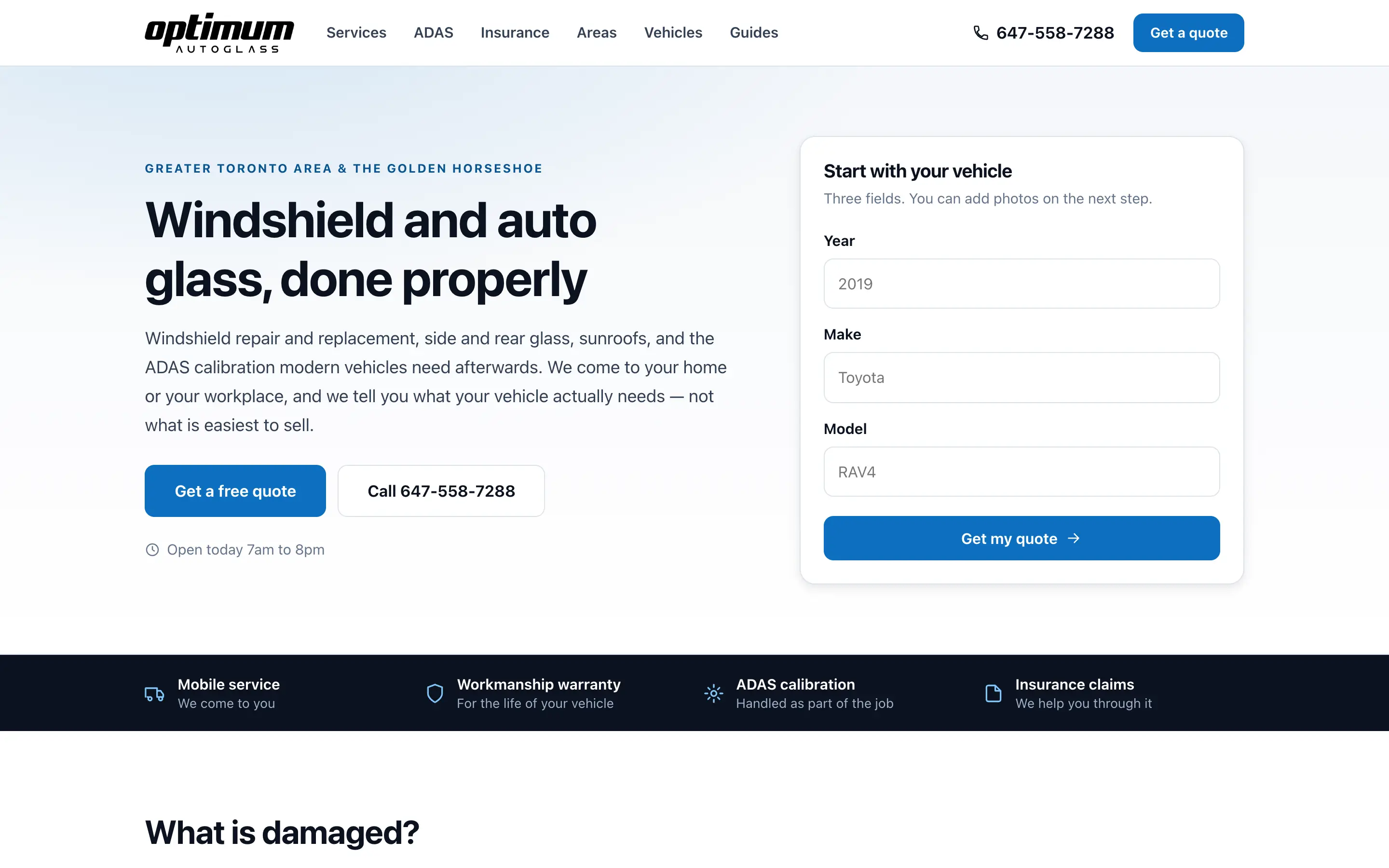
An auto glass site that asks for the vehicle first, explains ADAS and insurance plainly, and has a landing page for every service, area and vehicle people search.
A full online store with cart and checkout, built Arabic-first with a proper right-to-left layout and an English switch — not a translated afterthought.
How it works
The same process whatever the sector — because the thing that changes by industry is what gets built, not how the project runs.
A short call or a form. What you do, who buys from you, what you want the website to bring in. No technical questions.
InceptiCode comes back with a page-by-page plan and a fixed price. You approve it before anything is designed or built.
The key pages are designed properly, with your content in them rather than a wireframe. Two rounds of revisions are built into the price.
The approved design gets built — responsive, fast, with forms and tracking wired up as part of the work.
A staging link goes to you, and you go through it properly. Content, links, forms, phone numbers. Anything wrong gets fixed before launch.
InceptiCode handles DNS, hosting and the cutover, submits the sitemap to Google, and confirms tracking is recording. Then we stay reachable.
FAQ
The things a qualification checklist asks for, in this order: processes and equipment with real specifications, materials worked, achievable tolerances, certifications with registration numbers and scope, industries served, typical run sizes and lead times, and a quote request that accepts drawings. Everything else is supporting material. The most common expensive mistake in this sector is spending the budget on photography and animation and never publishing the equipment list the engineer came to find.
Yes, and it is worth doing properly because these files are frequently under NDA. Uploads are type-restricted and size-limited, stored outside the web root so no URL can reach them, scanned, and viewable only through an authenticated interface — not emailed around as attachments and never sitting on a public path that anyone who guesses the filename can read. STEP, IGES, DXF, DWG and PDF are the formats that matter; we will confirm the list against what your estimator actually opens.
It needs findability for a very specific kind of search, which is a different thing from broad SEO. Buyers search a process, a material and a region — "CNC machining aluminium Mississauga", "stainless fabrication Toronto", "injection moulding Ontario" — and those searches convert at a rate consumer traffic never approaches, because the person running them is sourcing right now. That requires a page per genuine process and material combination, which is structural work in the build rather than a campaign afterwards.
Only what you are contractually permitted to show, and check rather than assume — supply agreements in automotive and aerospace routinely prohibit naming the customer. Where you cannot name them, describing the sector, the part class and the constraint solved is nearly as persuasive to another engineer and carries none of the risk. A named logo you were not cleared to use is a commercial problem that a website should never create.
More answers on the FAQ page and the pricing page.
What you do, who buys from you, and what the site has to bring in. Business websites from C$2,490. We normally reply within one business day.