Gladiator Movers
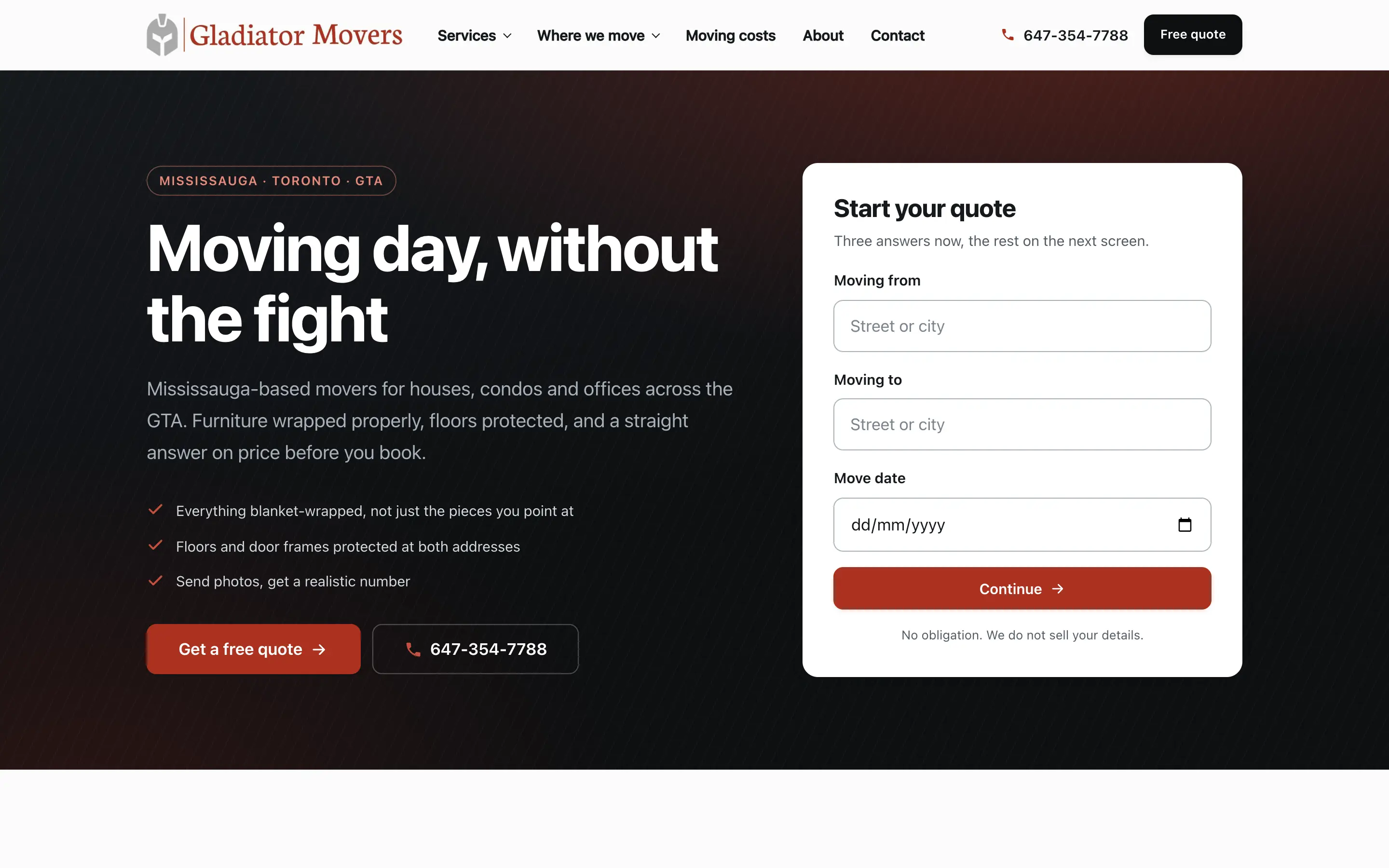
A moving company site where the quote starts in the hero, service pages exist for every job type, and the whole thing is built around one action: get a real number.
Toronto & the GTA
A second language added to a finished website is the most expensive way to get one. InceptiCode builds bilingual and multilingual sites in Toronto and the GTA the way they have to be built to be found — a real URL per language, reciprocal hreflang, localised metadata, and a contact form that works in the language it is written in.
A second language is scoped as part of the build · business websites from C$2,490
or call +1 647 691 5063
This site is built the way this page describes — live in English · Français · 简体中文 · العربية. View source and check the hreflang.
Real projects
The multilingual architecture described on this page is running on the site you are reading. Every claim below can be checked from the page source rather than taken on trust.
A moving company site where the quote starts in the hero, service pages exist for every job type, and the whole thing is built around one action: get a real number.
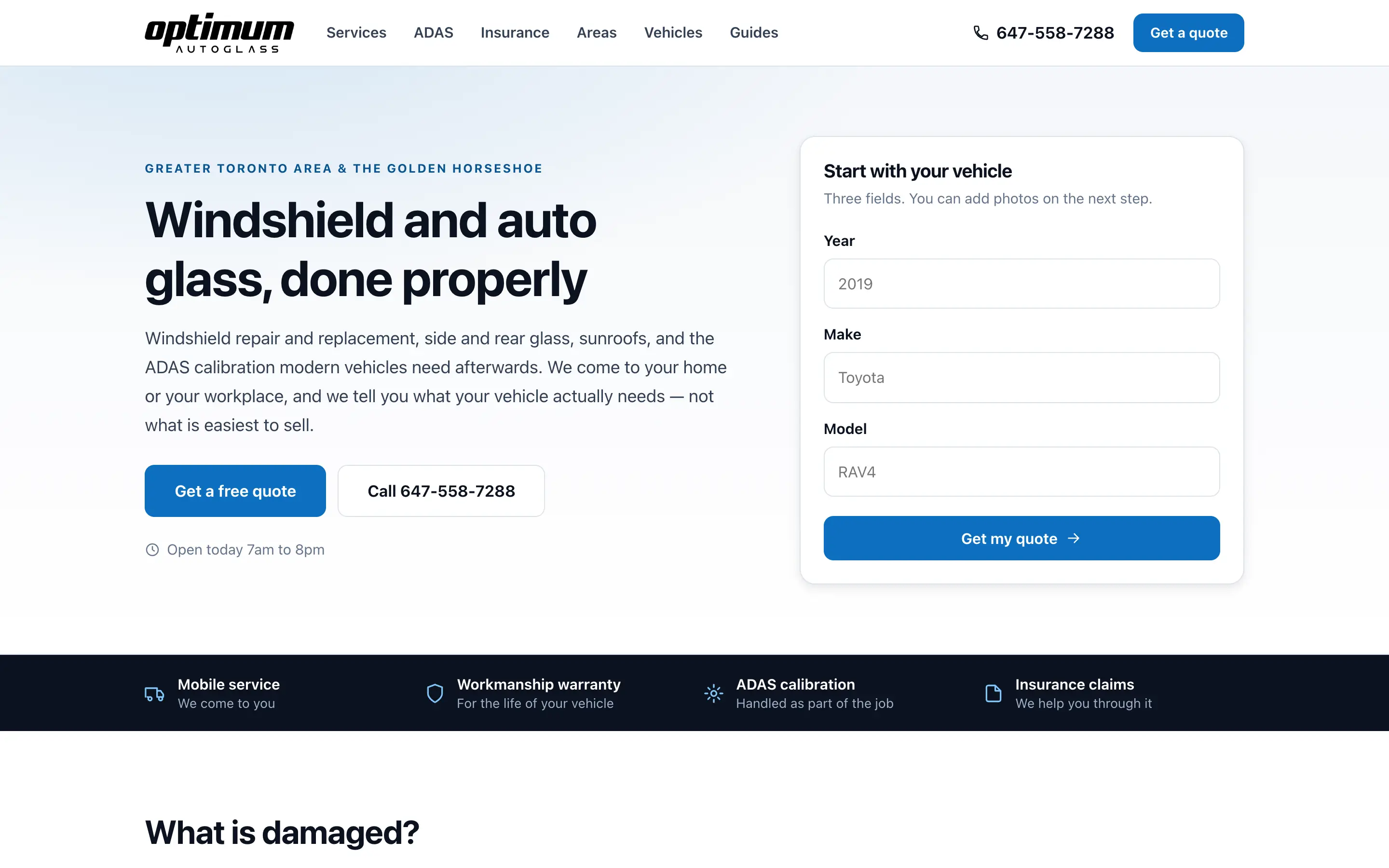
An auto glass site that asks for the vehicle first, explains ADAS and insurance plainly, and has a landing page for every service, area and vehicle people search.
A full online store with cart and checkout, built Arabic-first with a proper right-to-left layout and an English switch — not a translated afterthought.
Pricing
There is no flat price for a language, and any agency quoting one is quoting a translation rather than a build. The variables are how many pages genuinely need translating — usually far fewer than all of them — and whether you supply the copy. Business websites start at C$2,490; a second language is scoped on top of the page count you actually want in it.
Most requested
A professional site for an established business that needs to win more work.
From C$2,490
Most projects: C$2,490–C$4,990
Shopify or WooCommerce, set up to actually sell — not just to look finished.
From C$3,990
Most projects: C$5,900–C$8,900+
What's included
Tell us which languages and, more usefully, which PAGES need to exist in them. Most bilingual sites need the commercial pages in both languages and the blog in one — and deciding that up front is the single largest cost lever there is.
How it works
No discovery invoices, no scope creep, no surprise change orders halfway through.
A short call or a form. What you do, who buys from you, what you want the website to bring in. No technical questions.
InceptiCode comes back with a page-by-page plan and a fixed price. You approve it before anything is designed or built.
The key pages are designed properly, with your content in them rather than a wireframe. Two rounds of revisions are built into the price.
The approved design gets built — responsive, fast, with forms and tracking wired up as part of the work.
A staging link goes to you, and you go through it properly. Content, links, forms, phone numbers. Anything wrong gets fixed before launch.
InceptiCode handles DNS, hosting and the cutover, submits the sitemap to Google, and confirms tracking is recording. Then we stay reachable.
Why InceptiCode
Each language gets its own address — this site publishes English at the root, French under /fr/ and Simplified Chinese under /zh-cn/. That is what makes a page indexable, linkable, shareable and measurable in that language. Everything else about multilingual SEO depends on it existing.
Every language version declares every other, including itself, and x-default points at the language a visitor gets when we do not publish theirs. Emitted only where a translation genuinely exists — a hreflang pointing at an unfinished page asserts an equivalence that is not true, and search engines treat a broken set as no set at all.
Title, meta description, Open Graph card, breadcrumbs, and the language declared on the WebPage node all change with the language. A French page whose structured data claims en-CA contradicts its own hreflang, and a contradiction is worse than no signal — nothing gets trusted.
A contact form has to store Chinese characters, French accents and Arabic text without mangling them, and its own labels, errors and confirmation email have to be in the visitor's language. This is where most retrofits fail quietly: the page is translated and the form that produces the lead is not.
Each page in each language carries a status — missing, draft, machine-assisted, reviewed, published. Drafts build so they can be proofread on the real site, and are noindexed until a person who reads the language has signed them off. Adding a language later means adding an entry, not re-architecting.
Arabic, Hebrew, Farsi and Urdu need the layout to mirror, which is a CSS architecture decision made once at the start using logical properties. Retrofitting direction onto a layout built with left and right hardcoded is close to a rebuild of every component.
FAQ
It is cheaper and it does something different. A browser-translate widget renders a translated view of ONE URL. There is no second URL, so there is nothing for Google or Bing to index in the second language, no hreflang, and no way for a search in that language to find you — which is usually the entire reason a business wanted a second language. A widget is a convenience for a visitor who already found you in English. It is not a market.
It tells a search engine that two URLs are the same page in different languages, so it can serve the right one and stop treating the second as duplicate or thin content. Without it, a French page and an English page compete with each other instead of covering two audiences. It has to be reciprocal — every version in the set points at every other, including itself — and a set where one page points and the others do not is ignored entirely.
Yes, and that is the point of building it properly. Each language is separate content with its own title, description, headings and copy, not a lookup table pinned to the English wording. A price change on the French page does not wait for an English deploy, and a French page can say something the English one does not.
Either, and the honest recommendation is that you translate anything that carries a commercial claim. We build the architecture, wire the routing and metadata, and can arrange translation — but a native speaker in your own industry will write a better Chinese freight page than any generalist, and the difference is visible to the reader. Where you supply the copy, we treat it as content, not as strings to interpolate.
It is fine as a DRAFT and dangerous as a launch. A machine-translated page published as though it were equivalent to the English is, in search terms, a thin doorway page, and it reads to a native speaker as exactly what it is. The workflow we build tracks each page as missing, draft, reviewed or published, and only reviewed pages are indexable or reachable from the language switcher — so a half-finished translation can be proofread on the real site without entering the index.
The ones your customers actually buy in, which is a question about your own enquiry log rather than about census data. In the GTA the recurring pairs are English with Simplified Chinese — concentrated in Markham, Richmond Hill, Scarborough and North York — and English with French where there is a Quebec or federal lane. We would rather build two languages properly than six badly.
Our business websites start at C$2,490, and most business projects land between C$2,490–C$4,990. Online stores start at C$3,990, with larger stores typically C$5,900–C$8,900+. What moves a project up the range is page count, custom functionality, integrations, whether we write the content, and multilingual requirements. You get a fixed price in writing before any work starts.
Every site we build includes the technical foundations: page titles, meta descriptions, canonical URLs, structured data, a sitemap submitted to Google Search Console, fast loading, and a sensible page structure. That is what makes a site eligible to rank. Ongoing SEO — content, links, local listings — is separate work, and we will tell you honestly whether you need it or whether InceptiCode should point you at Google Ads instead.
Send us the language pair and roughly how many pages matter in the second one. That is enough for a real number — and if the honest answer is that a translation plugin covers what you need, we will say so.
Call us and you get a person, not a queue. We normally reply within one business day.