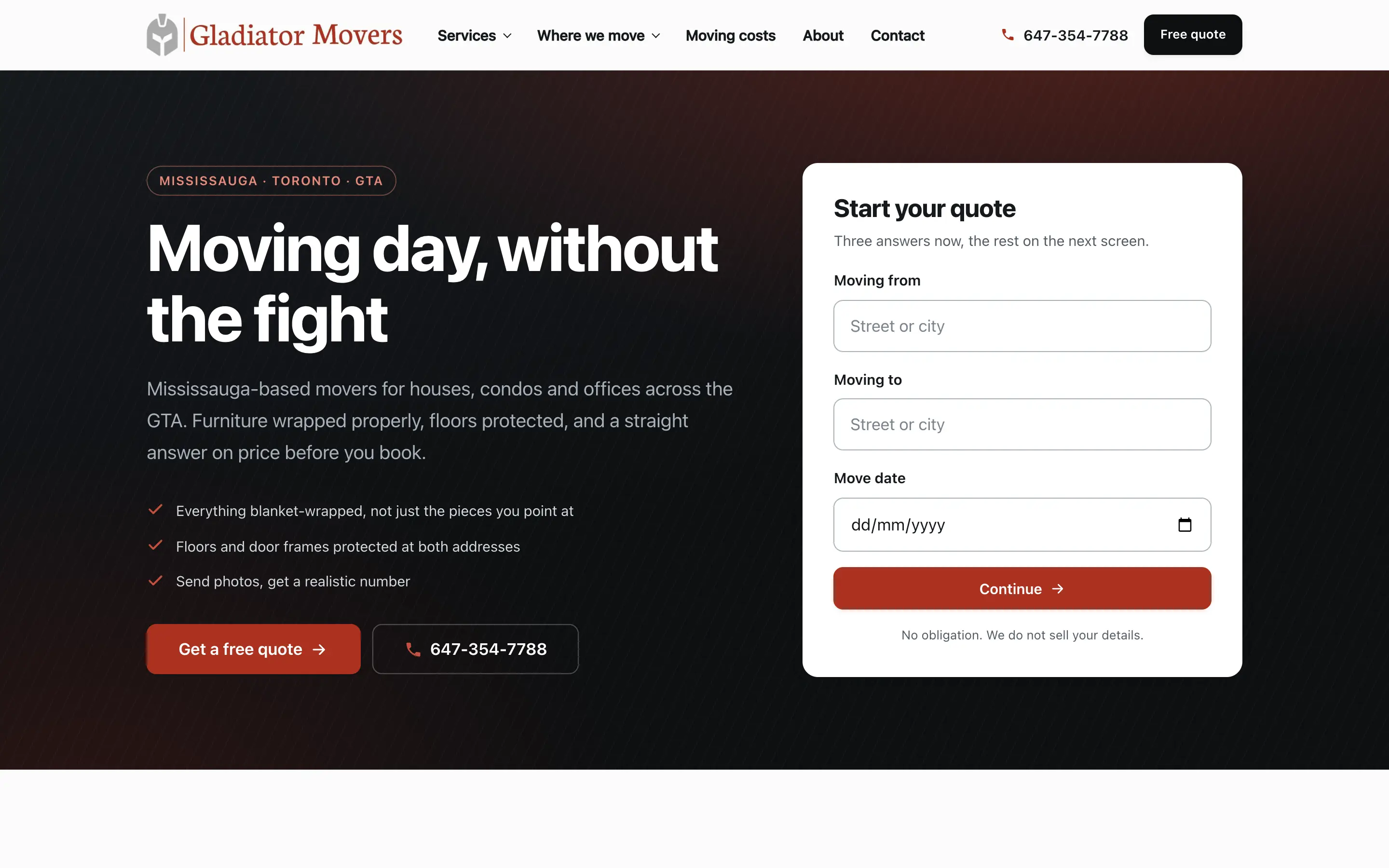
Gladiator Movers
A moving company site where the quote starts in the hero, service pages exist for every job type, and the whole thing is built around one action: get a real number.
Franchise & Multi-Location
A multi-location business has a problem no single-location business has: the same brand must appear locally in twenty places at once, and every solution to that pulls against brand control. InceptiCode builds franchise and multi-location websites around that tension — one system, real local pages, and a governance model that survives a franchisee who wants to change things.
Business websites from C$2,490, fixed in writing before design starts.
The buying decision
Two audiences buy from a franchise website and they want opposite things. A customer wants their nearest location: its hours, its address, its phone number, whether it does the specific thing they need, and they will not tolerate a store locator that makes them work. A prospective franchisee wants investment figures, territory availability, support and a disclosure process, and they are a months-long consideration with a completely different funnel. Behind both sits the decision that actually determines whether the site works: whether locations get real, indexable pages on the brand domain, or whether each franchisee is left to build their own site. The second is how a brand ends up competing against forty versions of itself for its own name.
What that changes
Six decisions that follow directly from how this purchase gets made, rather than from what looks good in a portfolio.
Its own URL, its own address and hours in structured data, its own reviews and staff, and enough genuinely local content that the page is not a template with a city swapped in. This is the single highest-value decision in the sector, and the failure mode on both sides is well known: fifty independent franchisee sites fragment the brand and split its search authority, while fifty identical templated pages are recognisable as a doorway set and get treated as one.
Detect or ask once, then send the visitor to a location page rather than a map pin with a phone number. Every additional step between a customer and their nearest location is measurable lost revenue, and the locator is used more than any other component on a multi-location site.
Franchisees need to edit hours, holiday closures, staff, local offers and photographs, and they must not be able to change the brand, the legal copy or the page structure. Defining that boundary in the CMS — rather than in a PDF brand guide nobody opens — is what keeps the estate consistent two years in.
Investment level, territory availability, training and support, and the disclosure process a prospective franchisee must go through. Mixing this into the customer-facing site confuses both audiences; it belongs on its own clearly signposted path, and it should be honest about the regulated steps rather than presenting an investment as a signup.
Hours, address and phone live in one record that feeds the location page, the locator, the structured data and, ideally, the Google Business Profile. Kept in four places they will disagree within a year, and inconsistent location data is both a customer-service problem and one of the clearest negative signals in local search.
Locations close, relocate and change owner constantly, and each event is a URL decision that nobody plans for. A defined pattern — redirect on relocation, a proper removal path on closure, a template that a new location can be live on in a day — prevents the accumulation of dead pages every mature multi-location site otherwise carries.
Common mistakes
Every one of these is something we have found on a live site in this industry, and every one costs enquiries that were already earned.
Evidence
InceptiCode has not built for a franchisor, and this sector sat on the published "not yet" list until this page replaced it. What transfers is the multi-location architecture itself, which is not a claim here but a thing you can open: Optimum Auto Glass runs thirty-six landing pages split across services, service areas and vehicle makes, each a legitimate page rather than a swapped noun, and this site runs twenty-one municipality pages under the same rule and a build gate that fails when two of them become too similar. That gate is the franchise problem stated mechanically, and it exists because the failure mode is so easy to reach.
A moving company site where the quote starts in the hero, service pages exist for every job type, and the whole thing is built around one action: get a real number.
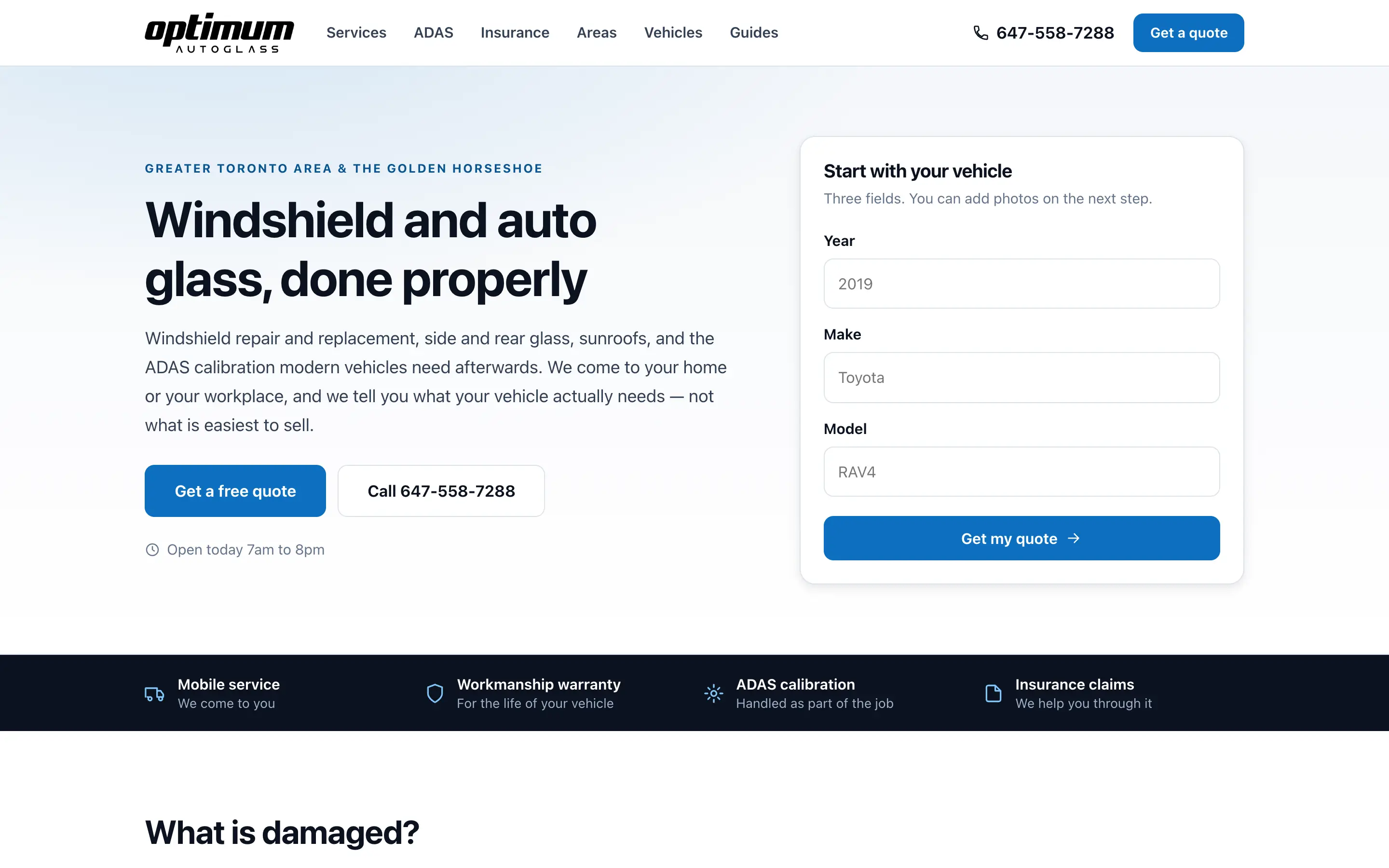
An auto glass site that asks for the vehicle first, explains ADAS and insurance plainly, and has a landing page for every service, area and vehicle people search.
A full online store with cart and checkout, built Arabic-first with a proper right-to-left layout and an English switch — not a translated afterthought.
How it works
The same process whatever the sector — because the thing that changes by industry is what gets built, not how the project runs.
A short call or a form. What you do, who buys from you, what you want the website to bring in. No technical questions.
InceptiCode comes back with a page-by-page plan and a fixed price. You approve it before anything is designed or built.
The key pages are designed properly, with your content in them rather than a wireframe. Two rounds of revisions are built into the price.
The approved design gets built — responsive, fast, with forms and tracking wired up as part of the work.
A staging link goes to you, and you go through it properly. Content, links, forms, phone numbers. Anything wrong gets fixed before launch.
InceptiCode handles DNS, hosting and the cutover, submits the sitemap to Google, and confirms tracking is recording. Then we stay reachable.
FAQ
Its own page, on the brand domain, in almost every case. Separate sites split the brand’s search authority across dozens of weak domains, guarantee inconsistent branding and legal copy, and put the brand in competition with itself for its own name — and they are much harder to withdraw from later than to avoid now. A location page on the main domain inherits the brand’s authority, keeps the estate consistent, and can still be genuinely local. The exception is a franchisee operating a substantially different business under a different name, which is a different problem.
By making each one carry something true of that location and untrue of the next — its team, its hours, its parking, what it does that another branch does not, its own reviews and photographs. The test we apply is deliberately harsh: if a page could have its city name swapped without a reader noticing, it should not exist. On this site that rule is mechanised rather than trusted, with a build check that measures overlap between location pages and fails above a threshold, and it is worth mechanising on any estate large enough that nobody can read all of it.
Yes, and the design question is the boundary rather than the permission. The pattern that holds up gives each franchisee control of the facts that are genuinely theirs — hours, holiday closures, staff, local offers, photographs, local events — and no ability to alter brand elements, legal copy or page structure. Draw it too tight and franchisees build their own sites anyway, which is the outcome you were trying to prevent; draw it too loose and the estate is inconsistent within a year. It belongs in the CMS permissions, not in a brand guide nobody opens.
More answers on the FAQ page and the pricing page.
What you do, who buys from you, and what the site has to bring in. Business websites from C$2,490. We normally reply within one business day.