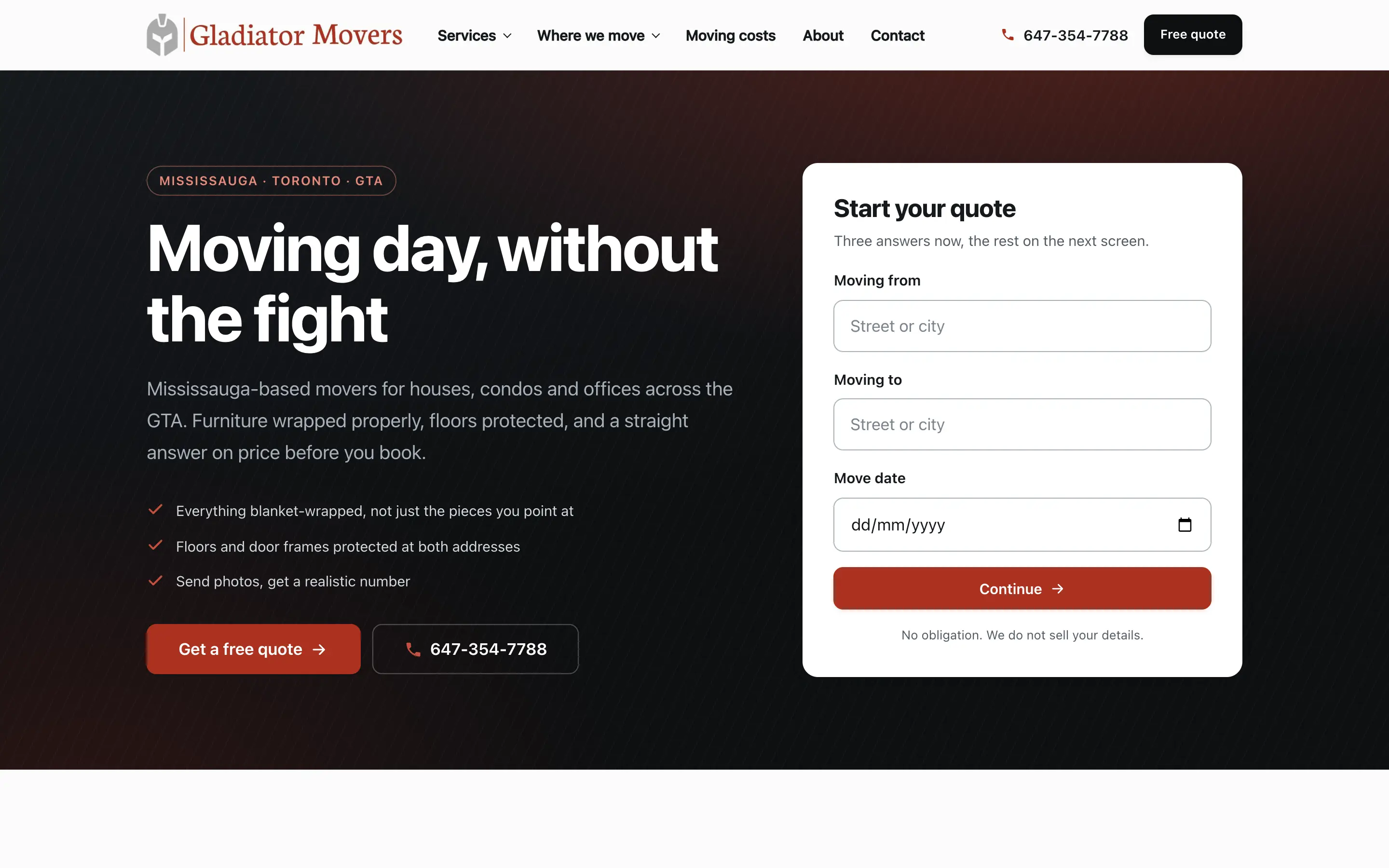
Gladiator Movers
A moving company site where the quote starts in the hero, service pages exist for every job type, and the whole thing is built around one action: get a real number.
Technology & SaaS
A software company’s website is the only one in this file that competes against its own product. The visitor can usually sign up and find out for themselves, so the marketing site’s job is not to persuade — it is to remove the specific doubts standing between a technical evaluator and a trial, quickly, without a single unsupported adjective. InceptiCode builds for Canadian software and technology companies on that basis.
Business websites from C$2,490, fixed in writing before design starts.
The buying decision
Nobody buys business software from a homepage, and the person who decides is rarely the person who signs. An engineer or an operations lead evaluates first, and they are hostile to marketing language in a way no other buyer in this file is: they want to know what it does, what it integrates with, what it costs, whether it will handle their data acceptably, and how fast they can try it without talking to anyone. If those five answers are not reachable in about two minutes they open a competitor tab, because in this category there is always a competitor tab. Then, and only then, a second buyer appears — someone with a budget who needs security, compliance and contract answers the first person never asked for.
What that changes
Six decisions that follow directly from how this purchase gets made, rather than from what looks good in a portfolio.
Hiding pricing behind a demo request filters out the evaluator and keeps the tyre-kicker, which is the opposite of the intent. Where pricing genuinely varies, publish the model — what the meter is, what a small team pays, where the enterprise line starts — rather than a number. "Contact us for pricing" is read as expensive and disqualifying, and it costs more evaluations than it protects.
For a technical product the docs consistently attract more qualified search traffic than the marketing pages, because engineers search for the problem, not the product. That means real HTML at real URLs, a search that works, code samples that can be copied, and no login wall in front of the reference. It also means the docs are where AI assistants read your product from, which is increasingly how an evaluator meets it first.
These three families produce most of the qualified search traffic in this category. Someone searching your product plus a tool they already run is far closer to buying than someone searching the category. Comparison pages have to be written honestly — name what the alternative is genuinely better at — because a technical reader who catches a distortion discounts everything else on the site.
Self-serve and sales-led are different motions for different buyers, and forcing both through one call-to-action loses whichever one it was not designed for. Trial for the evaluator, demo for the budget holder, both visible, neither disguised as the other.
Where data is hosted, what certifications exist and which are in progress, sub-processors, uptime history, whether personal information stays in Canada. A trust page that answers these directly shortens procurement by weeks. Claiming a certification that is merely under way is the one mistake in this list that ends a deal outright.
A dated, public record of what shipped is the cheapest credibility signal a software company has, and its absence is read exactly as intended — as a product that is not moving. It is also the only page on a SaaS site with an honest reason to carry a fresh date, which matters because fabricated freshness everywhere else is worse than none.
Common mistakes
Every one of these is something we have found on a live site in this industry, and every one costs enquiries that were already earned.
Evidence
InceptiCode has not published a SaaS case study. What transfers is that this studio ships software rather than only marketing sites — the custom software and web application work is the same discipline — and that this site is itself built the way the section above argues for: static HTML that renders without JavaScript, content readable by AI crawlers, published prices rather than a contact form, and dates that are real or absent. We would rather point at a site you can inspect than at a logo wall.
A moving company site where the quote starts in the hero, service pages exist for every job type, and the whole thing is built around one action: get a real number.
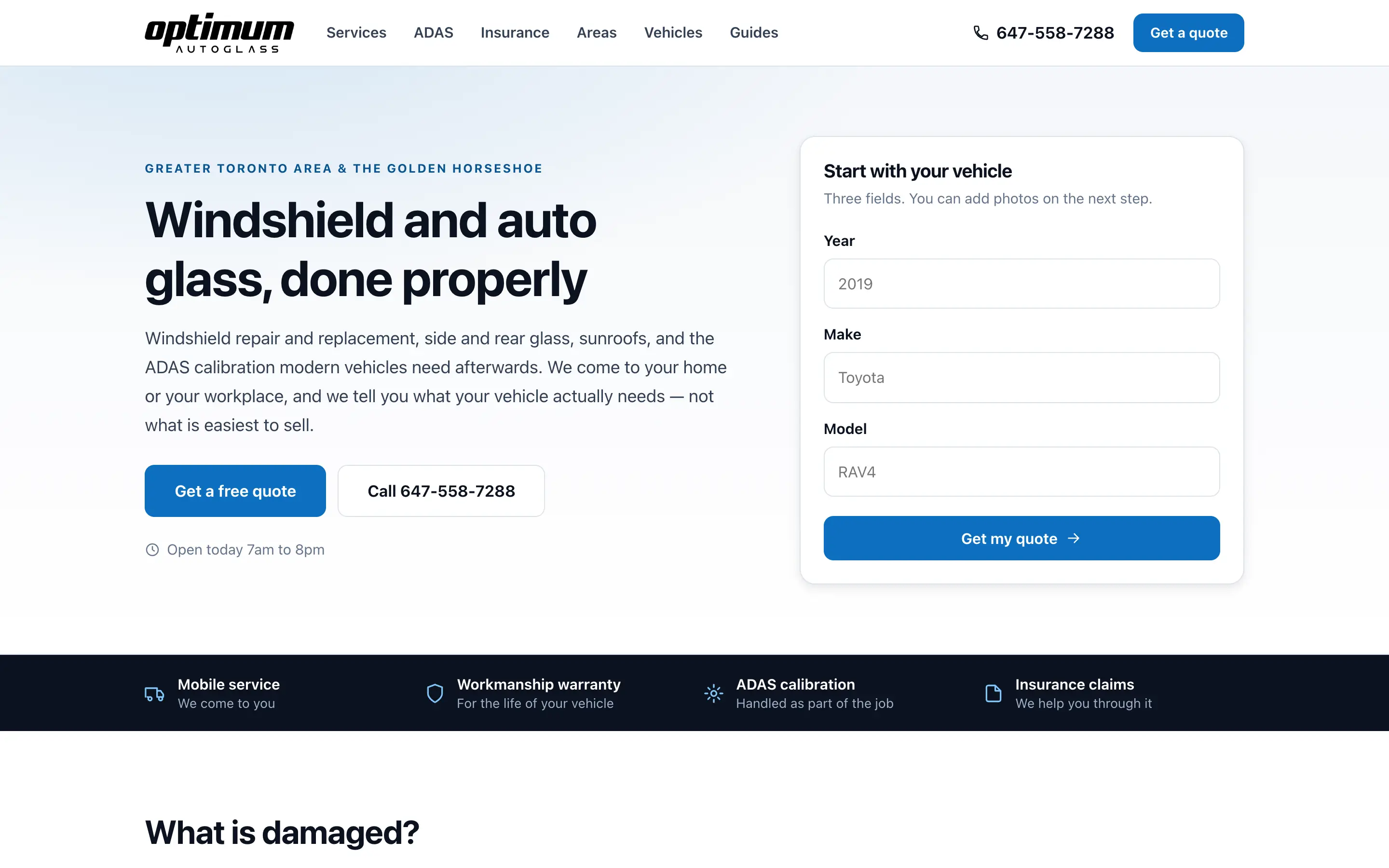
An auto glass site that asks for the vehicle first, explains ADAS and insurance plainly, and has a landing page for every service, area and vehicle people search.
A full online store with cart and checkout, built Arabic-first with a proper right-to-left layout and an English switch — not a translated afterthought.
How it works
The same process whatever the sector — because the thing that changes by industry is what gets built, not how the project runs.
A short call or a form. What you do, who buys from you, what you want the website to bring in. No technical questions.
InceptiCode comes back with a page-by-page plan and a fixed price. You approve it before anything is designed or built.
The key pages are designed properly, with your content in them rather than a wireframe. Two rounds of revisions are built into the price.
The approved design gets built — responsive, fast, with forms and tracking wired up as part of the work.
A staging link goes to you, and you go through it properly. Content, links, forms, phone numbers. Anything wrong gets fixed before launch.
InceptiCode handles DNS, hosting and the cutover, submits the sitemap to Google, and confirms tracking is recording. Then we stay reachable.
FAQ
Publish the model even where you cannot publish a number. The technical evaluator is filtering, and an absent price is treated as a disqualifying answer rather than an open question — they do not enquire, they move on. Where genuine variability makes a single figure impossible, state the meter, what a small team typically pays and where the enterprise conversation begins. That gives the evaluator enough to keep going and still leaves the negotiation intact.
Either works technically; what matters is that they are on your own domain, at stable URLs, in real HTML, and reachable without a login. A subdomain or a subdirectory is a fine choice and mostly a deployment preference. What is not fine is a third-party docs product that renders client-side, because search engines index it poorly and AI assistants — which execute no JavaScript at all — cannot read it, and for a technical product those two channels are where a large share of qualified discovery now happens.
They are among the highest-intent pages a software company can publish, and they are the easiest to ruin. Someone searching your product against a named alternative has a shortlist of two. The page works when it is honest enough to say what the alternative does better and who should choose it, because a technical reader who catches one unfair characterisation stops trusting the whole site. A comparison written as an advertisement converts worse than no page at all.
More answers on the FAQ page and the pricing page.
What you do, who buys from you, and what the site has to bring in. Business websites from C$2,490. We normally reply within one business day.