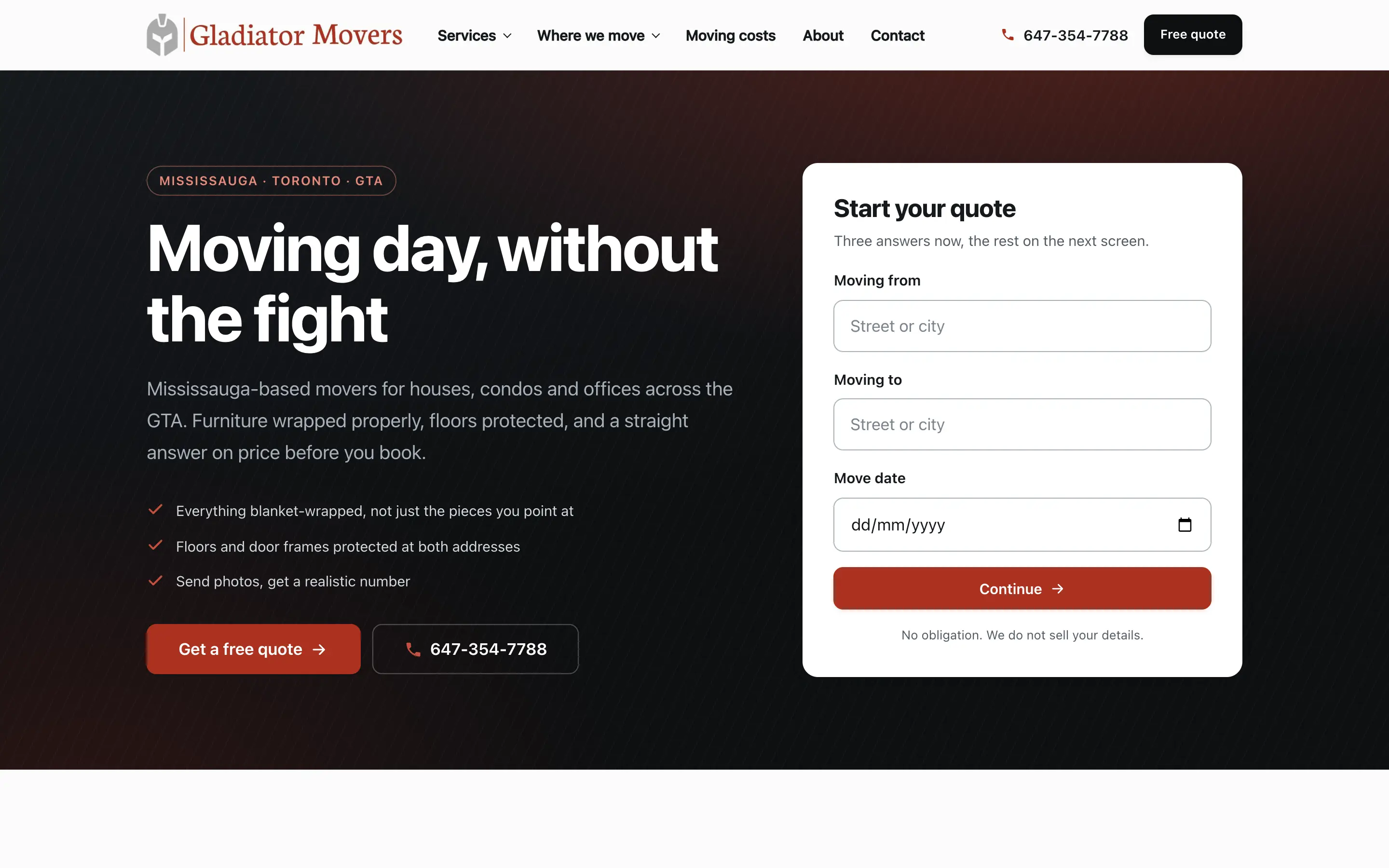
Gladiator Movers
A moving company site where the quote starts in the hero, service pages exist for every job type, and the whole thing is built around one action: get a real number.
Financial Services & Insurance
Financial services is the one sector in this list where the website is a regulated document. An insurance broker, a mortgage agent and a financial advisor in Ontario each work under a licence with rules about how they may describe themselves, and the same page has to also win a comparison against an aggregator that spends more on advertising in a week than the brokerage earns in a year. InceptiCode builds for both constraints at once.
Business websites from C$2,490, fixed in writing before design starts.
The buying decision
The client is not buying a product they understand — they are buying help choosing between products they cannot compare, from someone who is paid in a way they are unsure about. That makes disclosure the conversion mechanism rather than the legal footnote: a broker who explains plainly that they are paid by commission, and which carriers or lenders they have access to, outperforms one who leaves the reader to assume the worst. Underneath sits a structural fact that decides the whole build — the head terms in this category are owned by national aggregators and rate-comparison sites with budgets no local brokerage can meet, so the winnable searches are the specific, local, awkward ones the aggregators handle badly: the self-employed mortgage, the new-driver policy, the applicant with a thin credit file, the small commercial policy nobody wants to write.
What that changes
Six decisions that follow directly from how this purchase gets made, rather than from what looks good in a portfolio.
The licensed entity name, the licence held, the province, and — for a mortgage brokerage — the licence number displayed as the rules require. This is not decorative. It also happens to be a trust signal for the client, which is the useful part: a brokerage that shows its licence reads as the one with nothing to manage.
A page on "self-employed mortgage in Mississauga", "new driver insurance for a family policy" or "commercial insurance for a contractor" will outperform any attempt to rank for the generic rate query. These are the cases with a real conversation attached, and they are exactly what a national comparison engine cannot serve.
A payment calculator, an affordability estimate, a coverage-needs walkthrough. The value is not the number — it is that a visitor who is not ready to speak to anyone stays on the site, reaches something concrete, and leaves a contact. The number has to be conservative and clearly labelled as an estimate, because a figure the brokerage cannot stand behind creates the argument it was meant to prevent.
Commission from the carrier or lender, a fee, or a combination. Advisors dread this paragraph and it consistently improves enquiry quality, because the client who was going to ask suspiciously on the phone arrives having already read the answer.
Name, contact, situation, timeline. Never a SIN, never a date of birth, never an account or policy number through a public form. A brokerage that collects those in a web form has created a breach-notification obligation for itself in exchange for a marginally shorter phone call.
The list of who you can actually place business with is the single most useful fact on a brokerage website, because it is what separates you from a captive agent. It is also the fact most likely to go stale, so it belongs in one place that renders everywhere rather than being retyped on four pages.
Common mistakes
Every one of these is something we have found on a live site in this industry, and every one costs enquiries that were already earned.
Evidence
InceptiCode has not published a financial services case study — the sector sat on this site’s published "not yet" list until this page replaced it, and being straight about that is more useful than a stock photograph of a handshake. What transfers is real: Optimum Auto Glass is a build where the visitor arrives mid-problem and the site’s job is to convert an anxious comparison into a booked conversation, and the calculator work described above is running on a live GTA site today, built to give an honest range and hand off rather than to guess. The regulatory-copy discipline is the same one applied to the legal and healthcare pages here.
A moving company site where the quote starts in the hero, service pages exist for every job type, and the whole thing is built around one action: get a real number.
An auto glass site that asks for the vehicle first, explains ADAS and insurance plainly, and has a landing page for every service, area and vehicle people search.
A full online store with cart and checkout, built Arabic-first with a proper right-to-left layout and an English switch — not a translated afterthought.
How it works
The same process whatever the sector — because the thing that changes by industry is what gets built, not how the project runs.
A short call or a form. What you do, who buys from you, what you want the website to bring in. No technical questions.
InceptiCode comes back with a page-by-page plan and a fixed price. You approve it before anything is designed or built.
The key pages are designed properly, with your content in them rather than a wireframe. Two rounds of revisions are built into the price.
The approved design gets built — responsive, fast, with forms and tracking wired up as part of the work.
A staging link goes to you, and you go through it properly. Content, links, forms, phone numbers. Anything wrong gets fixed before launch.
InceptiCode handles DNS, hosting and the cutover, submits the sitemap to Google, and confirms tracking is recording. Then we stay reachable.
FAQ
You can publish rates, and the difficulty is operational rather than legal: a rate on a page is a rate you have to keep current, and a stale one is worse than none because the conversation opens with a correction. The pattern that works for most brokerages is a clearly dated indicative range with the conditions stated, or no number at all plus a calculator that produces an estimate. What we will not build is a headline rate implying an offer that only a fraction of applicants would qualify for.
For mortgage and life-coverage work, usually yes, and the reason is not the arithmetic — a visitor can find a calculator anywhere. It is that yours keeps the visitor on your site at the moment they become willing to identify themselves, and it lets them reach a number without phoning, which is the whole barrier. Build it conservative, label the estimate honestly, and hand off to a real conversation. InceptiCode has built exactly this pattern for a live GTA business in another sector, and the design rule that made it work was refusing to output more precision than the inputs justified.
By not competing where they are strong. The national aggregators own the generic rate query and will continue to, because the spend gap is not closeable. What they serve badly is the specific and the local: the self-employed applicant, the newcomer with no Canadian credit history, the small commercial policy, the client who wants to be advised in a language other than English. Those searches carry lower volume and far higher intent, they convert into a conversation rather than a form fill, and a local brokerage can own them outright.
More answers on the FAQ page and the pricing page.
What you do, who buys from you, and what the site has to bring in. Business websites from C$2,490. We normally reply within one business day.