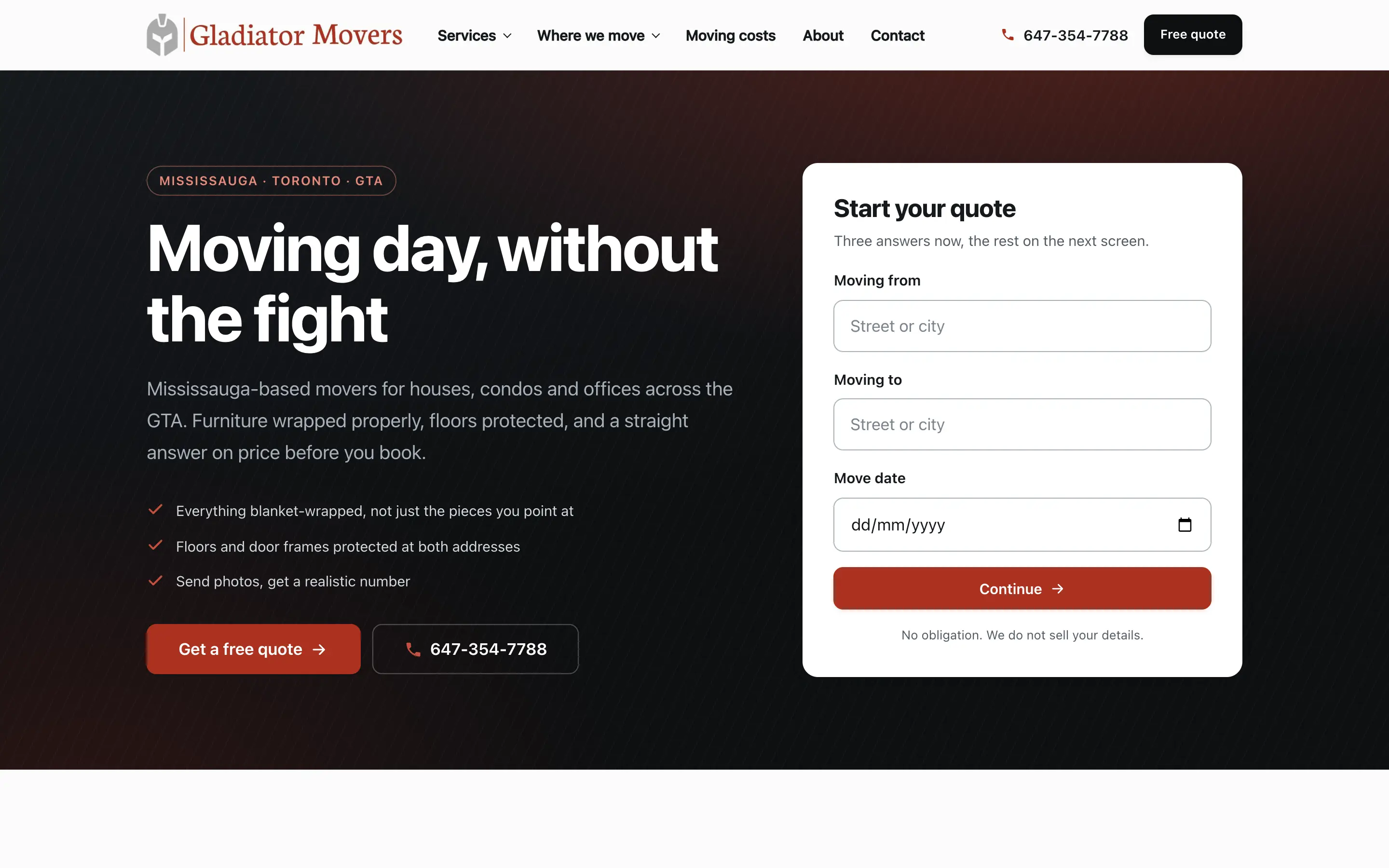
Gladiator Movers
A moving company site where the quote starts in the hero, service pages exist for every job type, and the whole thing is built around one action: get a real number.
Accounting & Bookkeeping
An accounting practice acquires most of a year’s new clients inside about ten weeks, and spends the other forty-two weeks with a website nobody is reading. InceptiCode builds accounting and bookkeeping sites in Toronto and the GTA around that shape — a site that converts hard in season, sells recurring work out of season, and moves client documents without email attachments.
Business websites from C$2,490, fixed in writing before design starts.
The buying decision
Two different purchases wear the same job title. The first is a deadline: a person or a small company needs a return filed, they are late or nearly late, and they are choosing on availability, price and whether the practice will actually take them on this year — a decision made in weeks, sometimes days. The second is a switch: a business that already has an accountant is quietly unhappy about responsiveness and is looking for a monthly relationship, and that decision takes months and turns on trust and on what the engagement includes. A site written entirely for the first buyer wins a season of low-value one-off returns; a site written entirely for the second is silent in the only quarter that fills the pipeline.
What that changes
Six decisions that follow directly from how this purchase gets made, rather than from what looks good in a portfolio.
The most-searched question in the season is not "who is the best accountant", it is "who will take me". Capacity stated on the page — accepting personal returns until a given date, accepting corporate year-ends, closed for new bookkeeping until a month — converts better than any credential and saves the phone calls that end in no.
Personal tax, corporate year-end and T2, bookkeeping and payroll, HST filing, CRA review and audit support, business incorporation, cross-border and US filings, estate returns. These are separate searches by people with nothing in common, and the CRA-dispute page in particular reaches somebody with a letter in their hand and no interest in a services list.
The practice needs T4s, statements and, eventually, a SIN. Email is the wrong pipe and clients will use it anyway unless the site offers something easier — a portal link, an upload with an explicit retention statement, or a plain description of how to get documents in securely. This is the single most-used part of an accounting website and it is usually the least designed.
A personal return from a figure, a corporate package monthly, bookkeeping banded by transaction volume. Practices resist publishing this and then spend the season answering the same question by phone. A stated band with an honest note about what moves it filters out the enquiries that were never going to fit.
Seasonal load is the one performance question this sector actually has, and it arrives at exactly the moment the practice has no capacity to deal with a broken form. Static pages, a form pipeline that does not depend on the practice’s mail server, and monitoring that alerts somebody who is not mid-return.
Filing dates, instalment dates, payroll remittance dates. This is the most linked-to and most returned-to content an accounting practice can publish, it is genuinely useful, and it is the one place where a stale year does visible damage — so it needs an owner and a date on the page, not a copy-paste each spring.
Common mistakes
Every one of these is something we have found on a live site in this industry, and every one costs enquiries that were already earned.
Evidence
InceptiCode has not published an accounting case study. What transfers is the seasonal-conversion problem and the intake problem, both of which this studio has solved elsewhere: Gladiator Movers is built around a demand curve with a hard peak and an enquiry that has to be captured before a competitor answers, and the lead pipeline behind this site’s own forms stores the minimum it needs, states its retention, and does not route anything through a mailbox. Those are the two mechanics an accounting site lives or dies on, and we would rather name them than imply a sector history we do not have.
A moving company site where the quote starts in the hero, service pages exist for every job type, and the whole thing is built around one action: get a real number.
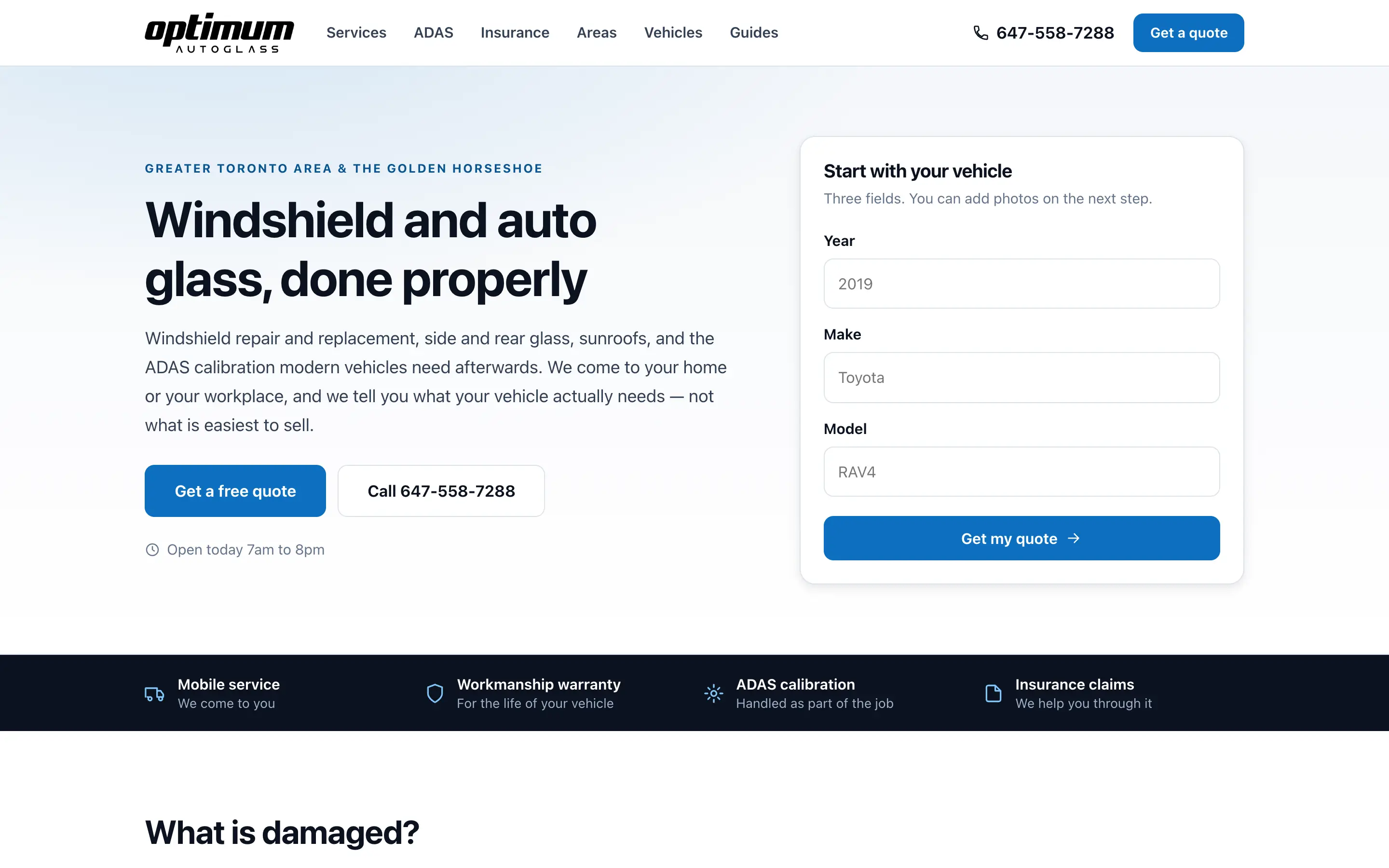
An auto glass site that asks for the vehicle first, explains ADAS and insurance plainly, and has a landing page for every service, area and vehicle people search.
A full online store with cart and checkout, built Arabic-first with a proper right-to-left layout and an English switch — not a translated afterthought.
How it works
The same process whatever the sector — because the thing that changes by industry is what gets built, not how the project runs.
A short call or a form. What you do, who buys from you, what you want the website to bring in. No technical questions.
InceptiCode comes back with a page-by-page plan and a fixed price. You approve it before anything is designed or built.
The key pages are designed properly, with your content in them rather than a wireframe. Two rounds of revisions are built into the price.
The approved design gets built — responsive, fast, with forms and tracking wired up as part of the work.
A staging link goes to you, and you go through it properly. Content, links, forms, phone numbers. Anything wrong gets fixed before launch.
InceptiCode handles DNS, hosting and the cutover, submits the sitemap to Google, and confirms tracking is recording. Then we stay reachable.
FAQ
A band, yes — and the reason is specific to this sector rather than general. Your one-off seasonal buyer is filtering on price and will not phone to discover it; your recurring buyer is filtering on what is included and needs to see the shape of a monthly engagement. Publishing "personal returns from X, corporate packages from Y a month, bookkeeping banded by volume" answers both without committing you to a number for work you have not seen. Practices that do this report the same thing every time: fewer calls, and a much higher proportion of them worth having.
Through anything except an email attachment, and the site’s job is to make the alternative more convenient than the habit. If the practice already runs a portal, the site should link into it from every page a client lands on rather than burying it in a footer. If it does not, an upload with an explicit statement of where files go, who can see them and when they are deleted is both safer and more reassuring than the status quo. What does not work is saying nothing, because the default is a client emailing a SIN to whichever address they can find.
Build it for both and time the emphasis. The pages that win in season — capacity, deadlines, personal tax, "I got a CRA letter" — want to be finished and indexed well before the season starts, because a page published in March has not been crawled and ranked by the time it is needed. The recurring-engagement pages can be written afterwards. The mistake is treating the site as a seasonal campaign, since the monthly bookkeeping client who arrives in September is worth several of the returns that arrive in April.
More answers on the FAQ page and the pricing page.
What you do, who buys from you, and what the site has to bring in. Business websites from C$2,490. We normally reply within one business day.